Introduction
Banking is evolving faster than ever. Customers expect real-time services, regulators demand greater transparency, and fintech companies are continuously raising the bar with flexible, API-driven solutions.
Yet, many banks still rely on legacy core systems that were never designed for this level of speed or complexity.
Instead of replacing everything at once, leading institutions are taking a more practical approach—modernizing step by step. At the center of this transformation, SAP S/4HANA is emerging as a financial digital core, connecting data, processes, and reporting across the enterprise.
At GBSI, we help banks adopt this phased approach—ensuring modernization happens without disrupting daily operations or compliance requirements.
Why Core Banking Modernization Is a Strategic Priority
Core banking modernization is no longer just an IT initiative—it is a business necessity.
Banks today face multiple pressures simultaneously. Legacy systems slow down decision-making due to batch processing. Customers expect instant services and seamless digital experiences. Fintech competitors launch new features faster. Regulatory requirements demand real-time reporting and transparency. And maintaining outdated systems continues to increase operational costs.
The challenge is not whether to modernize, but how to do it in a controlled, low-risk way.
The Real Problem with Legacy Banking Systems
Legacy systems often appear stable, but they create hidden inefficiencies.
Many still rely on batch-based processing, which delays reporting and decision-making. Data is spread across multiple systems, making it difficult to get a consistent and reliable view. Product configurations are rigid, slowing down innovation. Over time, continuous patches and workarounds increase technical debt and maintenance costs.
These limitations directly impact business performance—slowing response time, increasing costs, and limiting growth.
SAP S/4HANA as the Financial Digital Core
Modern banks are no longer trying to force everything into a single system. Instead, they adopt a layered architecture.
In this setup, core banking systems continue to handle transactions, while SAP S/4HANA acts as a centralized financial and operational layer.
This approach allows banks to modernize without replacing existing systems entirely.
With SAP S/4HANA:
● Financial data is available in real time
● A single source of truth replaces fragmented systems
● Analytics are embedded directly into processes
● Decision-making becomes faster and more reliable
At GBSI, we design SAP architectures that integrate seamlessly with existing banking systems, enabling faster value realization with minimal disruption.

Transforming Financial Operations with SAP
Traditional financial operations are reactive. Data is collected, processed later, and then reconciled manually.
SAP S/4HANA changes this model completely.
Financial data is processed as it is generated. This reduces dependency on end-of-period activities and minimizes manual reconciliation. Teams can work with accurate, up-to-date information at all times.
This shift allows finance teams to move from operational tasks to strategic analysis.
At GBSI, we help banks implement Central Finance and real-time reporting frameworks, enabling faster financial close cycles and improved visibility.
Integration Across Core Banking and Digital Ecosystems
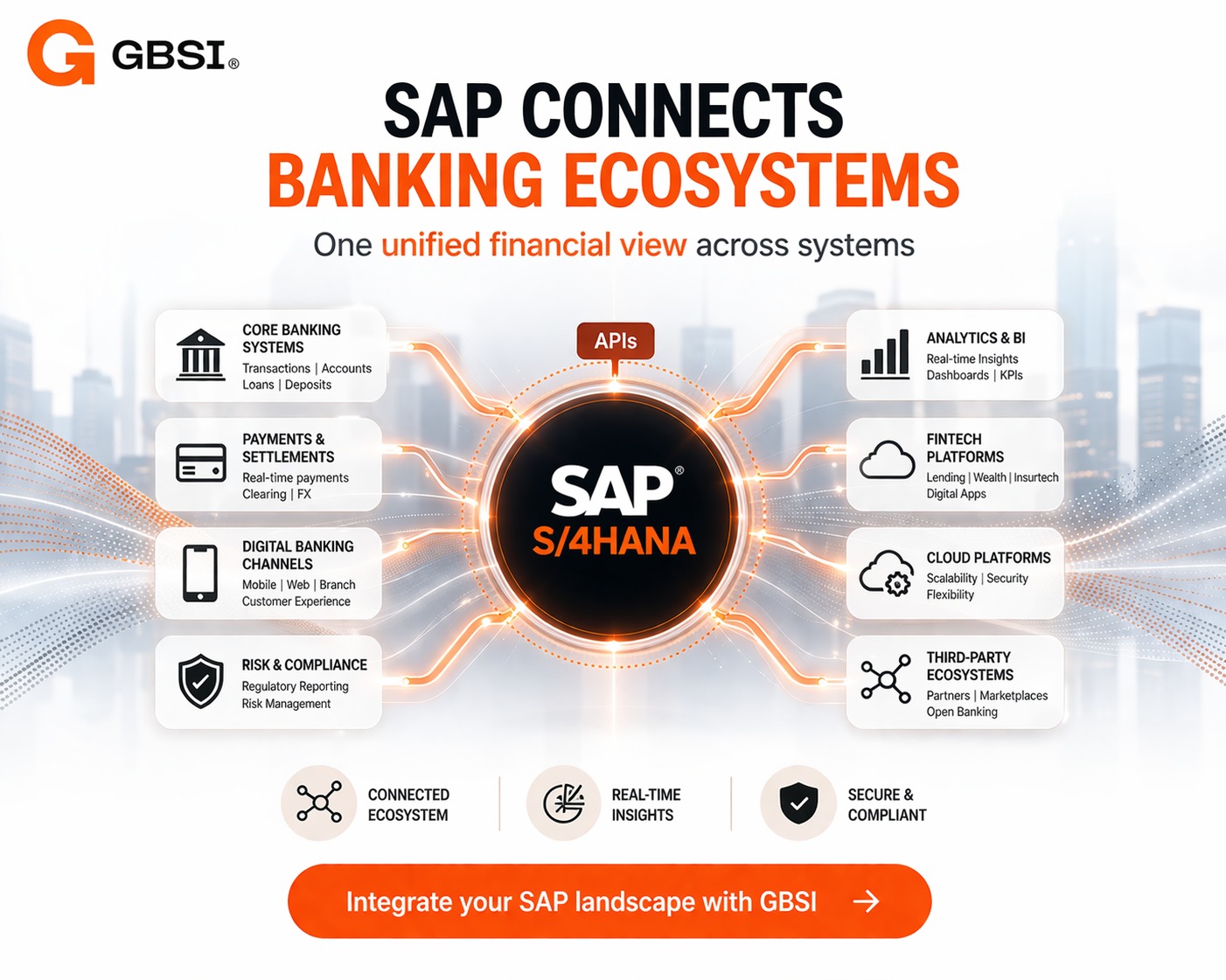
SAP S/4HANA does not operate in isolation. Its value comes from how it integrates with the broader banking ecosystem.
It connects with core banking platforms, digital channels, payment systems, and compliance tools. This creates a unified financial layer across all operations.
Modern integration is driven by APIs and platforms like SAP BTP, allowing banks to connect systems without disrupting existing processes.
GBSI enables this integration by designing flexible, API-driven SAP landscapes that support innovation without increasing complexity.
Real-Time Data, Analytics, and Intelligent Automation
One of the biggest shifts in modern banking is how data is used.
Instead of waiting for reports, teams can now access real-time insights directly within SAP systems.
SAP S/4HANA enables:
● Continuous analytics embedded into operations
● AI-driven forecasting for better planning
● Faster fraud detection and risk analysis
● Automation of routine processes
This changes how decisions are made—moving from reactive to proactive.
At GBSI, we help organizations leverage SAP analytics and AI capabilities to build data-driven decision environments.
Cloud, Security, and Regulatory Compliance
In banking, modernization must go hand-in-hand with control.
SAP S/4HANA supports flexible deployment models, including cloud, on-premise, and hybrid environments. This allows banks to meet data residency and regulatory requirements while still benefiting from scalability.
Security is built into the architecture, with strong access controls, monitoring, and data protection mechanisms.
GBSI ensures that SAP implementations are aligned with global regulatory standards, security frameworks, and compliance requirements.

GBSI’s Approach to SAP Banking Transformation
At GBSI, we take a practical and structured approach to modernization.
We focus on:
● SAP S/4HANA finance implementations
● Central Finance strategies
● Legacy system transformation
● Hybrid architecture integration
● Phased migration roadmaps
Our priority is simple: 👉 Keep the business running while transformation happens.
Business Impact of SAP Modernization
Banks adopting SAP S/4HANA see measurable outcomes.
They can launch products faster, reduce operational costs, and gain real-time visibility into financial data. Reporting becomes more accurate, compliance becomes easier, and decision-making becomes faster.
Over time, this leads to improved efficiency and stronger competitive positioning.
A Practical Roadmap to Transformation
Successful modernization starts with understanding the current landscape.
Banks need to assess their systems, identify bottlenecks, and define a clear target architecture. From there, transformation should be executed in phases—starting with financial integration and expanding gradually.
Strong governance and risk management are essential throughout the journey.
GBSI supports banks across every stage, ensuring a smooth and controlled transition.
Conclusion
Core banking modernization is not about replacing everything overnight.
It is about building a flexible, connected architecture that can evolve over time.
SAP S/4HANA plays a critical role in this journey by acting as a financial digital core—bringing together data, processes, and insights without disrupting existing systems.
👉 The future of banking belongs to organizations that can adapt faster, operate smarter, and make better decisions.
GBSI helps you make that transition with confidence.