Over the last few weeks, I’ve been deliberately searching for clear, practical explanations of how modern AI actually works — beyond the hype, buzzwords, and vendor marketing.
During that search, I came across a YouTube video that finally connected the dots for me. Not from a “how to code” perspective, but from how AI systems are architected and why that matters for business leaders perspective.
It reinforced an important realization:
👉 Executives don’t need to build AI — but they must understand the fundamentals to make the right strategic decisions.
Watch this original video by KodeKloud at this link: https://youtu.be/ZaPbP9DwBOE
Here are the core concepts every C-suite executive and Director should be familiar with today:
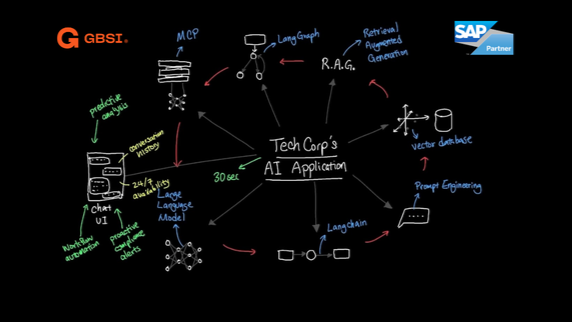
🧠 LLM (Large Language Models)
LLMs are the intelligence engines behind modern AI. They read, understand, summarize, reason, and generate language at scale. Think of them as highly capable reasoning engines, not databases or rule systems.
They don’t “know your business” by default — which leads to the next concept.
🎯 Prompt Engineering
This is how humans guide AI thinking. Well-designed prompts dramatically improve accuracy, relevance, and reliability.
From a leadership perspective, prompt engineering is about:
- Asking the right business questions
- Providing clear context
- Setting boundaries and expectations
The quality of input directly impacts the quality of output.
📦 Vector Databases
Traditional databases store records. Vector databases store meaning.
They allow AI systems to find information based on context and similarity, not exact keywords. This is what enables AI to “understand” documents, policies, SOPs, contracts, and historical data.
This is foundational for enterprise AI.
🔁 RAG (Retrieval Augmented Generation)
RAG is how organizations safely combine AI with their own data.
Instead of relying only on what an AI model was trained on, RAG allows it to:
- Retrieve relevant internal knowledge
- Use that information to generate accurate, contextual responses
This significantly reduces hallucinations and makes AI usable in regulated, mission-critical environments.
⚙️ Workflows, LangChain, and LangGraph
Modern AI systems don’t work in a single step.
They follow workflows:
- Retrieve data
- Analyze context
- Apply rules
- Make decisions
- Trigger actions
Frameworks like LangChain and LangGraph help structure these workflows so AI systems behave more like digital workers, not chatbots — capable of multi-step reasoning and controlled execution.
🔗 MCP (Model Context Protocol)
MCP enables AI systems to securely interact with external tools, systems, and services.
This is a major step toward AI that can:
- Read from enterprise systems
- Take actions (with governance)
- Operate consistently across platforms
It’s a key enabler for scalable, enterprise-grade AI adoption.
🚀 What this enables next (and why leaders should care)
The future of Chat-based AI is not just “Q&A.”
We are moving toward Chat UIs that enable:
- Predictive analysis (anticipating risks, shortages, failures, trends)
- Workflow automation (end-to-end process execution, not just advice)
- Proactive compliance alerts (issues identified before audits or failures occur)
AI will increasingly act as: 👉 an analyst 👉 an operator 👉 a risk monitor
— all embedded into daily business operations.
Executive takeaway
AI strategy is no longer just an IT topic.
Understanding these fundamentals helps leaders:
- Ask better questions
- Set realistic expectations
- Make smarter investment decisions
- Govern AI responsibly
- Turn AI from experimentation into competitive advantage
My learning journey continues — and I strongly believe this foundational understanding will separate organizations that use AI from those that truly benefit from it.
If this resonates, I’d love to hear how you’re thinking about AI at the leadership level.