Introduction
The food and beverage industry is entering a new phase of complexity.
Regulations are tightening. Consumer expectations are evolving. Product cycles are shortening. And the volume of product data—from ingredients to labeling—is increasing rapidly.
For many organizations, traditional systems are no longer enough to manage this complexity.
This is where Product Lifecycle Management (PLM) with SAP is becoming critical—helping companies bring structure, visibility, and control across the entire product lifecycle.
At GBSI, we help food manufacturers adopt SAP PLM to modernize operations while ensuring
compliance, traceability, and faster time-to-market.
Why PLM Matters More Than Ever in the Food Industry
The food industry is facing a combination of pressures that are difficult to manage in silos.
Regulatory frameworks such as FDA and FSMA are becoming more detailed, requiring companies to maintain accurate and accessible records across the supply chain.
At the same time, consumers expect complete transparency—ingredient sourcing, allergen details, sustainability impact, and nutritional value.
On top of that, rising ingredient costs, frequent product variations, and sustainability goals are adding further complexity.
👉 The result: Product lifecycle management is no longer optional—it is foundational.
The Growing Complexity of Product Development
Food product development today involves multiple interconnected factors.
Formulations must balance cost, compliance, nutrition, and quality. Recipes evolve frequently due to changing regulations and consumer trends. Product variations increase as companies cater to different markets and dietary needs.
Without a structured system, managing this becomes difficult. Disconnected tools lead to:
- Inconsistent product data
- Version control issues
- Delays in approvals
- Increased compliance risks
This is where PLM brings a structured approach.

Compliance Is Driving Change in Food Manufacturing
Regulatory requirements are expanding in both scope and depth.
Companies are expected to track product data across sourcing, production, storage, and distribution. Traceability is no longer limited to internal systems—it extends across the entire supply chain.
Even small inconsistencies in labeling or ingredient data can lead to compliance risks.
Traditional systems struggle here because data is scattered across spreadsheets, ERP systems, and local tools.
PLM solves this by creating a centralized and controlled environment where all product-related data is managed consistently.
How SAP PLM Enables End-to-End Traceability
Traceability has become a critical requirement—not just for compliance, but for operational efficiency.
Organizations need to track:
- Ingredient sourcing
- Formulation changes
- Supplier data
- Product versions
- Distribution history
With SAP PLM, all this information is connected within a single system.
Every change is recorded. Every version is tracked. Every product has a complete history.
👉 This makes it possible to respond quickly to audits, recalls, and regulatory checks. At GBSI, we design SAP PLM solutions that make traceability built-in, not reactive.

Breaking Data Silos with PLM
One of the biggest challenges in food manufacturing is fragmented data.
Different teams—R&D, quality, compliance, and supply chain—often work with separate systems.
This leads to inconsistencies, delays, and errors.
SAP PLM eliminates these silos by creating a single source of truth for all product data. Teams can:
- Access validated formulations
- Track changes in real time
- Collaborate across functions
- Reduce duplication of effort
👉 This significantly improves efficiency and accuracy across the organization.
Accelerating Innovation and Time-to-Market
Speed is becoming a key competitive advantage.
New product launches, seasonal variations, and evolving consumer trends require companies to move faster than ever.
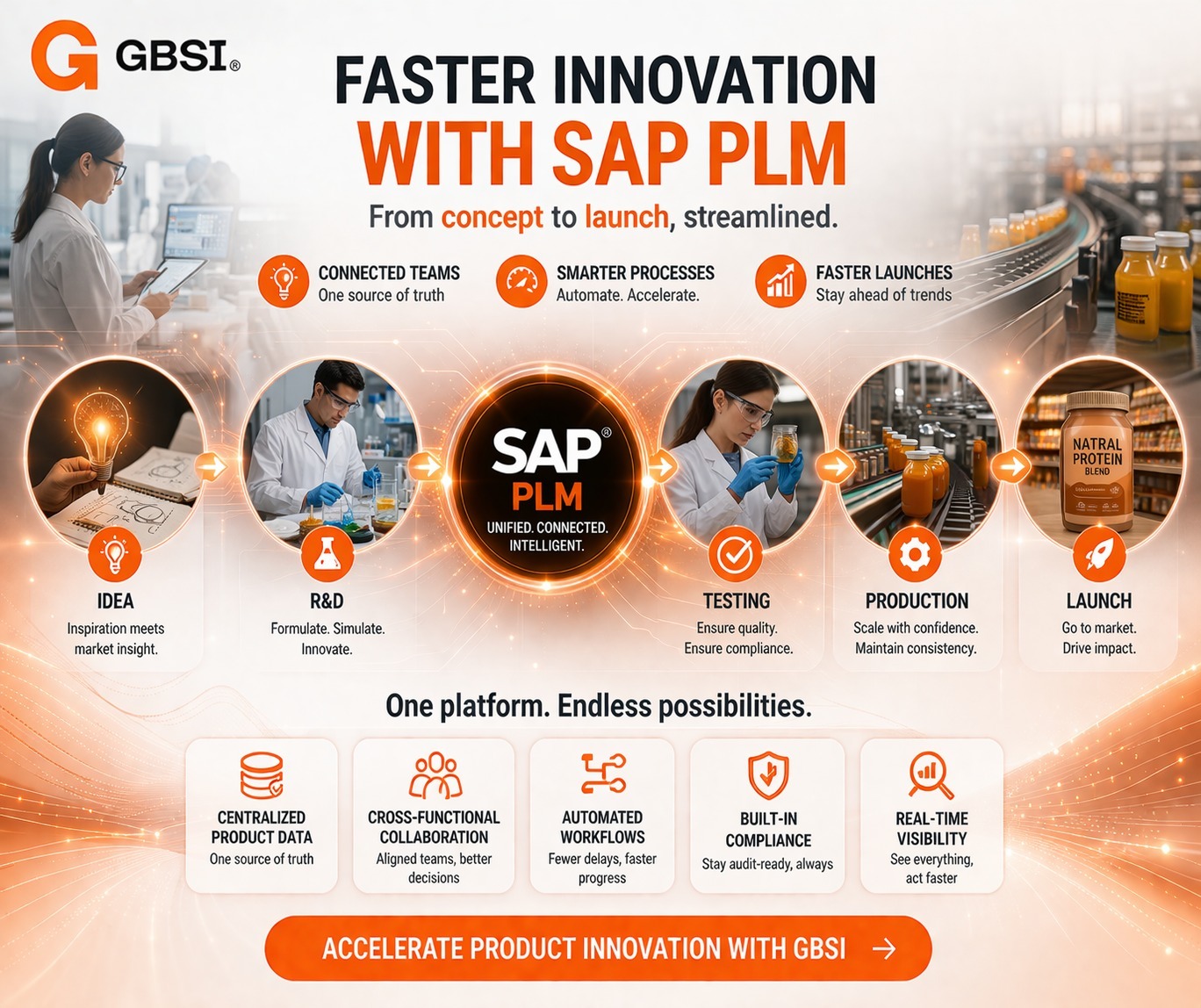
SAP PLM enables this by:
- Connecting R&D with manufacturing early
- Centralizing product data for faster iterations
- Automating workflows and approvals
- Improving launch readiness
This allows companies to innovate faster without compromising compliance or quality.
At GBSI, we help organizations build PLM-driven processes that balance speed with control.

Why Traditional Systems Are No Longer Enough
Most organizations rely on multiple systems—ERP, quality tools, spreadsheets, and supplier platforms.
While each system serves a purpose, none provides a complete view of the product lifecycle. This creates gaps in:
- Data consistency
- Version control
- Collaboration
- Traceability
PLM does not replace these systems—it connects them.
It acts as a structured layer where product data, processes, and changes are managed consistently.
SAP PLM as a Connected Digital Platform
SAP PLM goes beyond data management—it supports the entire lifecycle. From initial idea to product launch and beyond, it enables:
- Structured product development
- Integrated compliance management
- Real-time collaboration
- Lifecycle visibility
It also connects with other SAP solutions, creating a unified ecosystem for innovation and operations.
At GBSI, we help organizations implement SAP PLM as part of a broader digital transformation strategy.
GBSI’s Approach to PLM Transformation
At GBSI, we focus on making PLM practical and scalable. Our approach includes:
- PLM strategy and roadmap definition
- SAP PLM implementation
- Integration with ERP and other systems
- Workflow automation
- Ongoing optimization and support
👉 The goal is simple:
Enable organizations to manage complexity without slowing down innovation.
Business Impact of SAP PLM
Organizations adopting SAP PLM experience:
- Improved product quality
- Faster product development cycles
- Better compliance management
- Reduced operational inefficiencies
- Enhanced visibility across the lifecycle
Over time, this leads to stronger competitiveness and better market responsiveness.
Conclusion
The food industry is becoming more complex—and more connected.
Managing this complexity requires more than isolated systems. It requires a unified approach to product data, processes, and compliance.
SAP PLM provides that foundation.
By bringing structure to product lifecycle management, it enables organizations to operate with greater control, move faster, and adapt to changing demands.
👉 The future belongs to companies that can manage complexity without slowing down.
GBSI helps you build that capability with SAP.