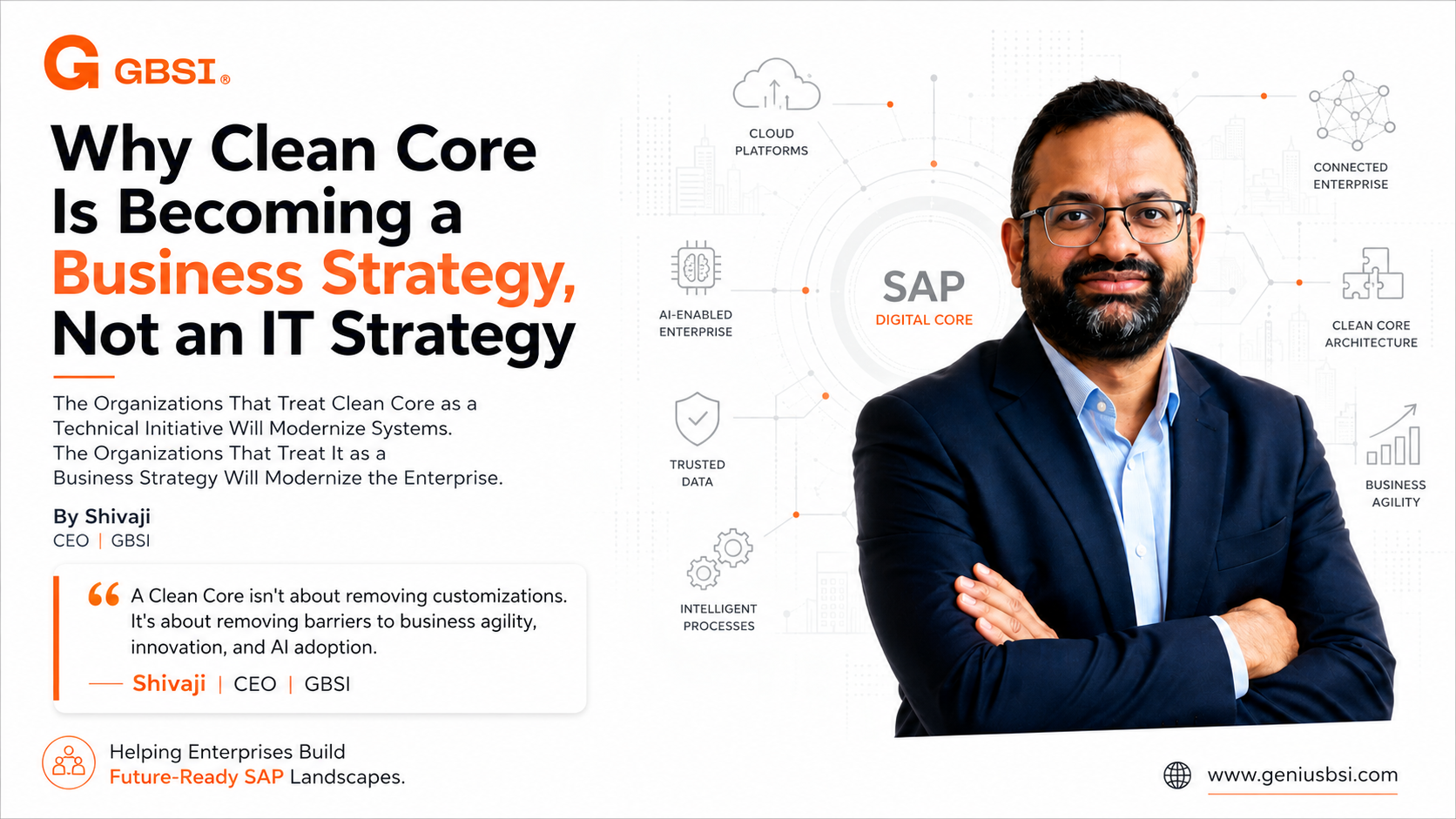
Why Clean Core Is Becoming a Business Strategy, Not an IT Strategy
The organizations that treat Clean Core as a technical initiative will modernize systems. The organizations that treat it as a business strategy will modernize the enterprise.
For years, conversations around SAP Clean Core have largely been confined to technology teams. It has been discussed in terms of custom code reduction, upgrade readiness, extensibility frameworks, and cloud migration. Those are important conversations—but they are no longer sufficient.
The enterprises gaining the greatest value from SAP transformation are approaching Clean Core from an entirely different perspective. They are not asking how to simplify their ERP landscape. They are asking how to build an organization that can continuously adapt to change.
That distinction matters.
Because in today's business environment, the ability to evolve faster than competitors has become a strategic advantage. And increasingly, that capability begins with the architecture that supports the business.
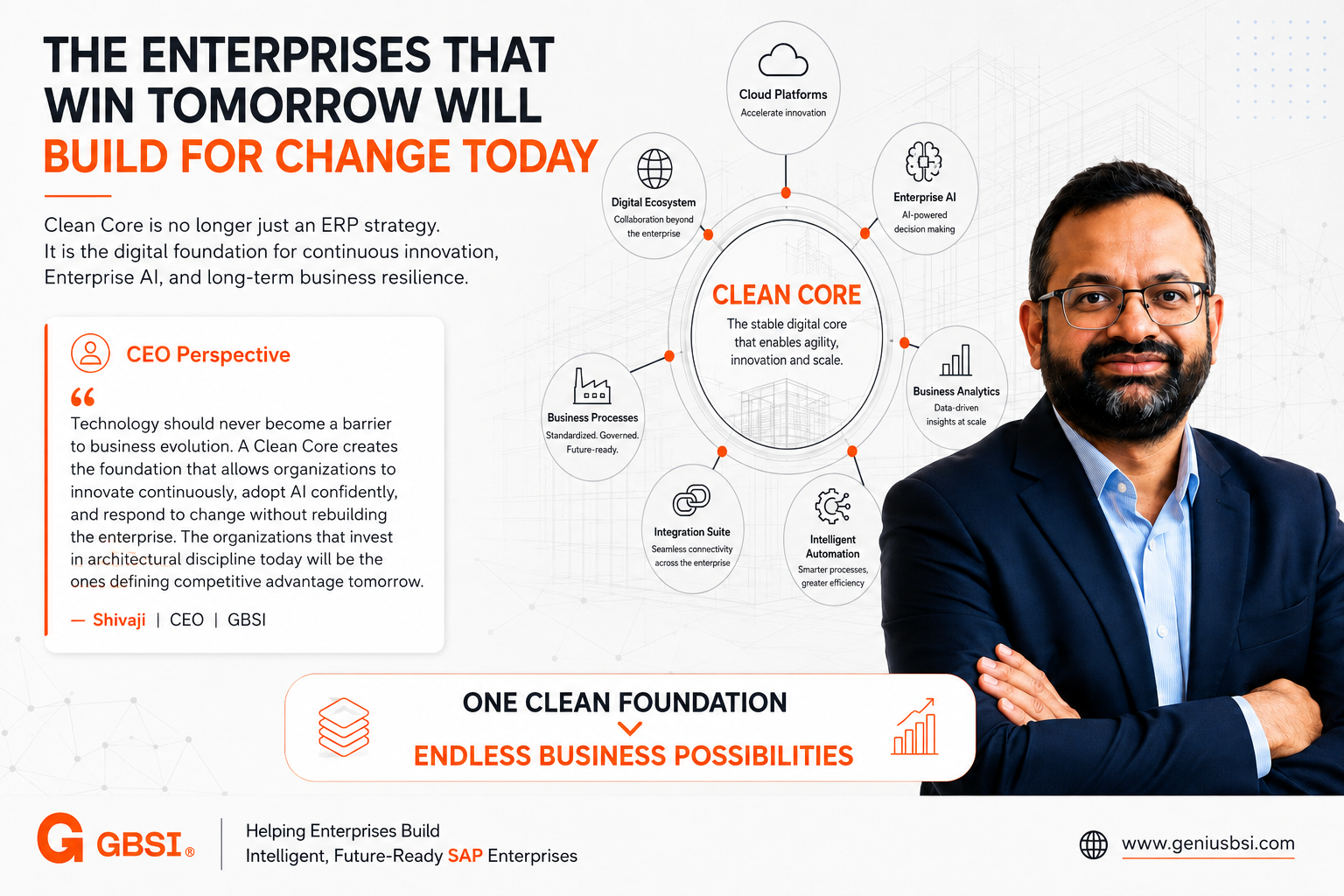
Clean Core is no longer an IT initiative.
It is becoming a business strategy.
The Cost of Complexity Is No Longer Hidden
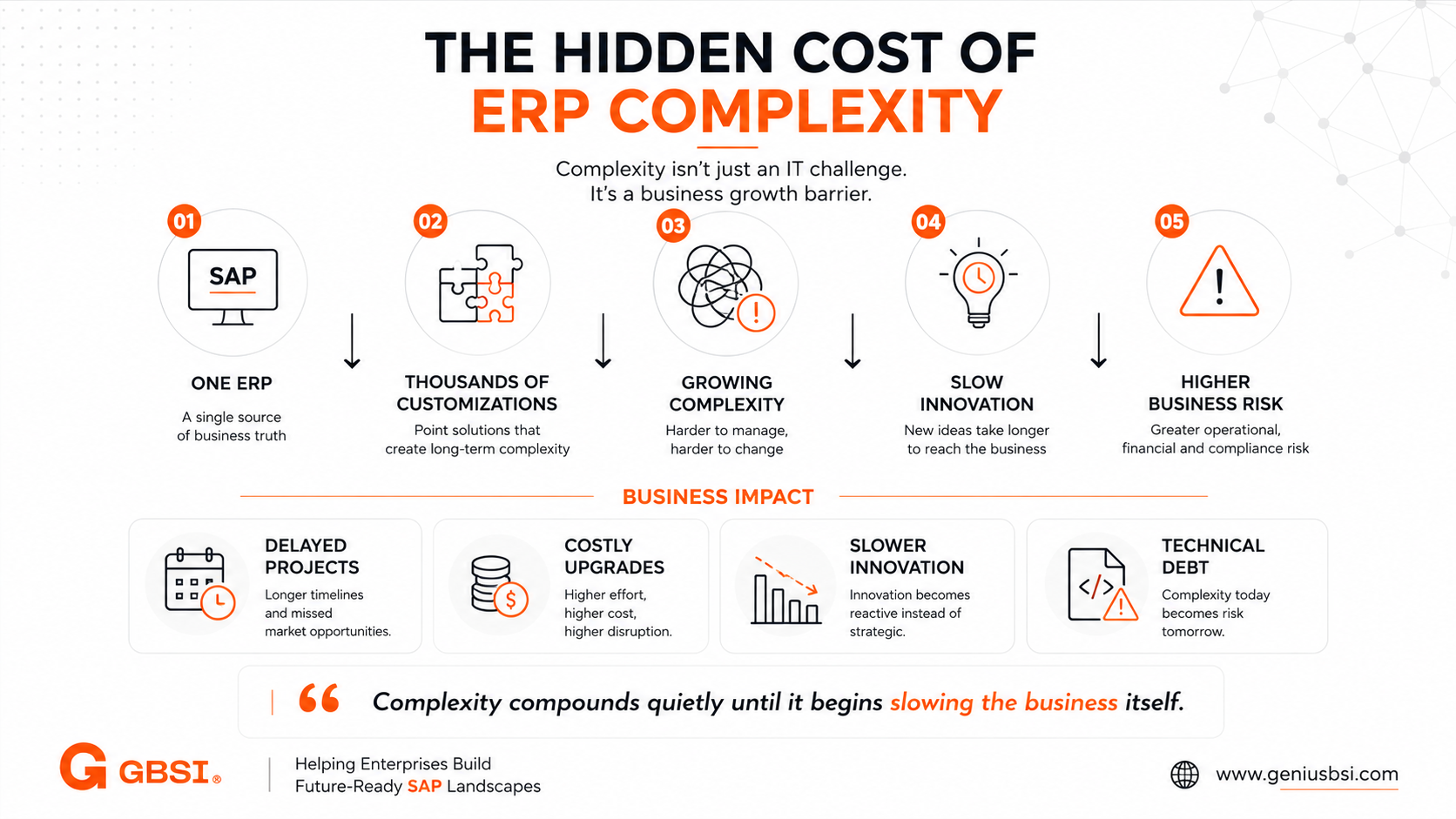
Most organizations didn't intentionally build complex SAP environments.
Complexity accumulated over years of business growth, acquisitions, regional requirements, changing regulations, and thousands of well-intentioned customizations. Every project solved an immediate business challenge. Few were designed with long-term agility in mind.
The result is an ERP landscape where every upgrade becomes expensive, every innovation requires extensive testing, and every new business initiative depends on navigating layers of technical debt.
The cost is not measured only in IT budgets.
It appears in delayed product launches, slower mergers and acquisitions, fragmented customer experiences, inconsistent data, and executive decisions based on information that arrives too late.
When business leaders ask why transformation projects take years instead of months, the answer often lies beneath the surface—in an ERP environment that has become increasingly difficult to evolve.
The real challenge isn't customization itself.
It's accumulated complexity.
Clean Core Creates Business Agility, Not Just Technical Simplicity
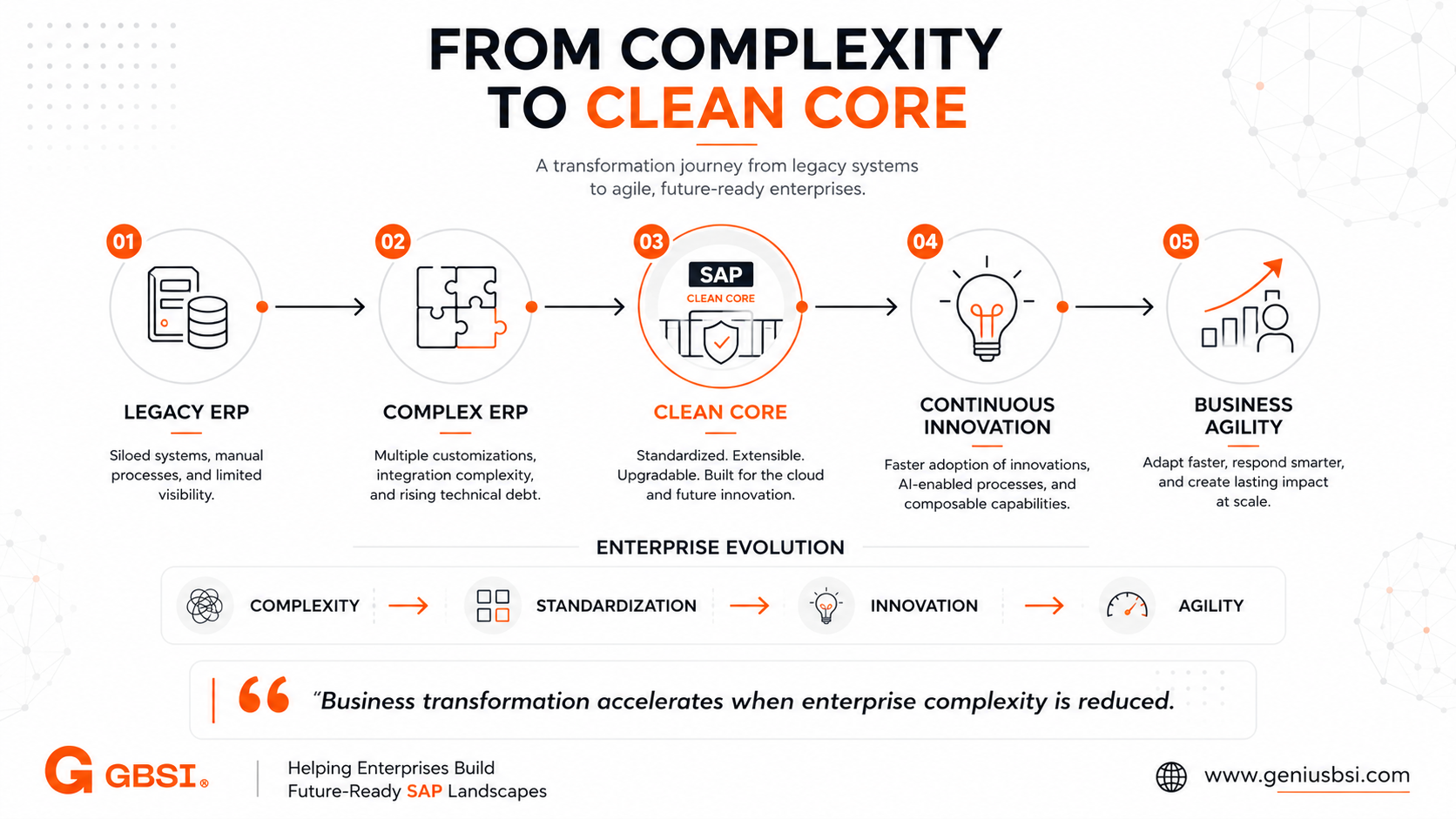
Many executives still associate Clean Core with reducing custom code.
That interpretation misses the larger opportunity.
A Clean Core creates an enterprise architecture that can absorb change without rebuilding the business every time priorities shift.
New acquisitions can integrate faster.
Business processes become easier to standardize globally.
Cloud innovations can be adopted without major redevelopment.
Regulatory changes can be implemented with significantly less disruption.
Most importantly, business teams can innovate without waiting for years of ERP redesign.
Think about modern airports.
Passengers rarely notice the infrastructure beneath the terminals. Yet every runway, control tower, baggage system, and security checkpoint must operate in perfect coordination for millions of travelers to move efficiently.
Enterprise architecture works the same way.
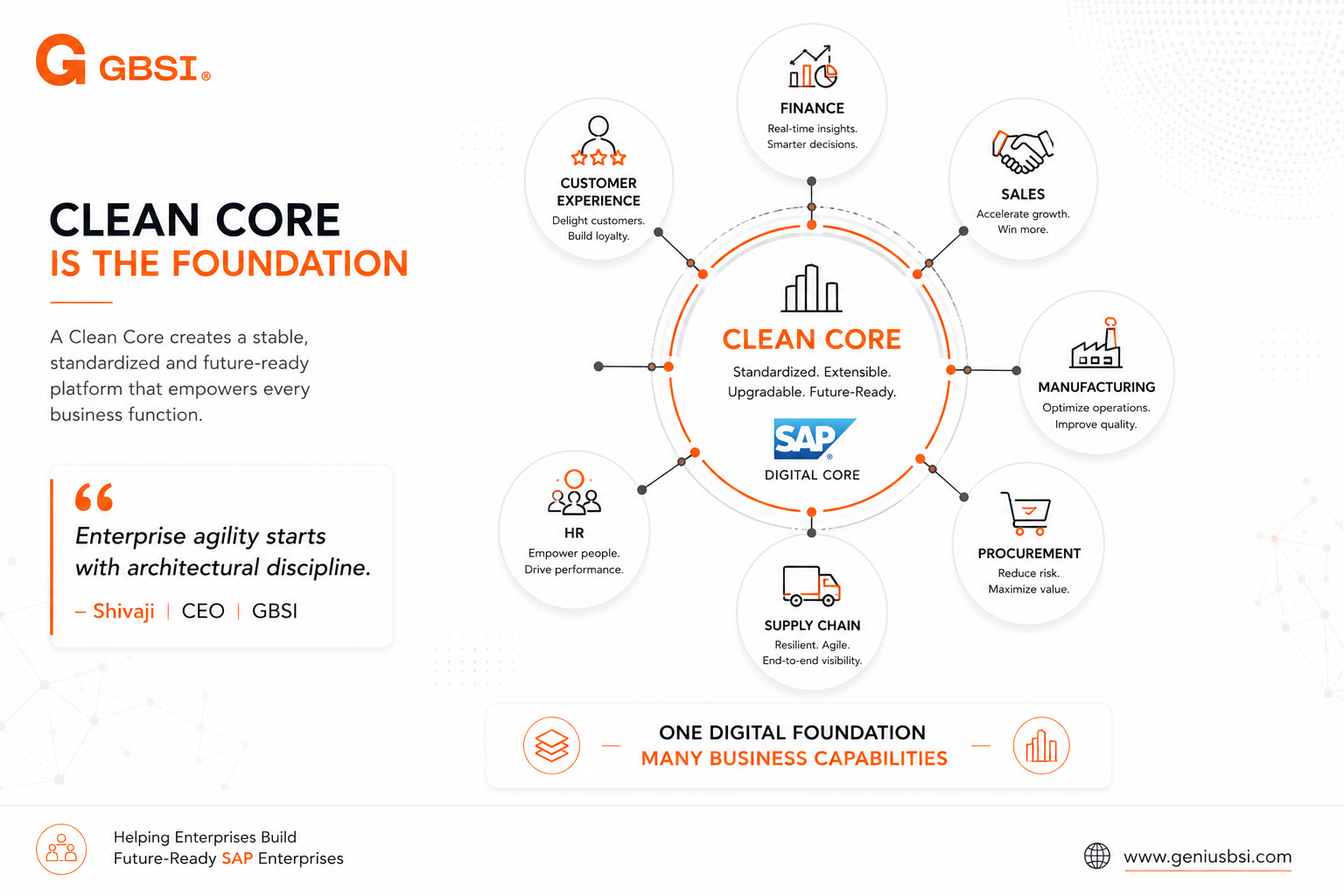
Customers rarely see ERP systems. But every customer experience, financial process, supply chain decision, and operational workflow depends on how well that digital foundation has been designed.
A Clean Core is that foundation.
The AI Conversation Changes Everything
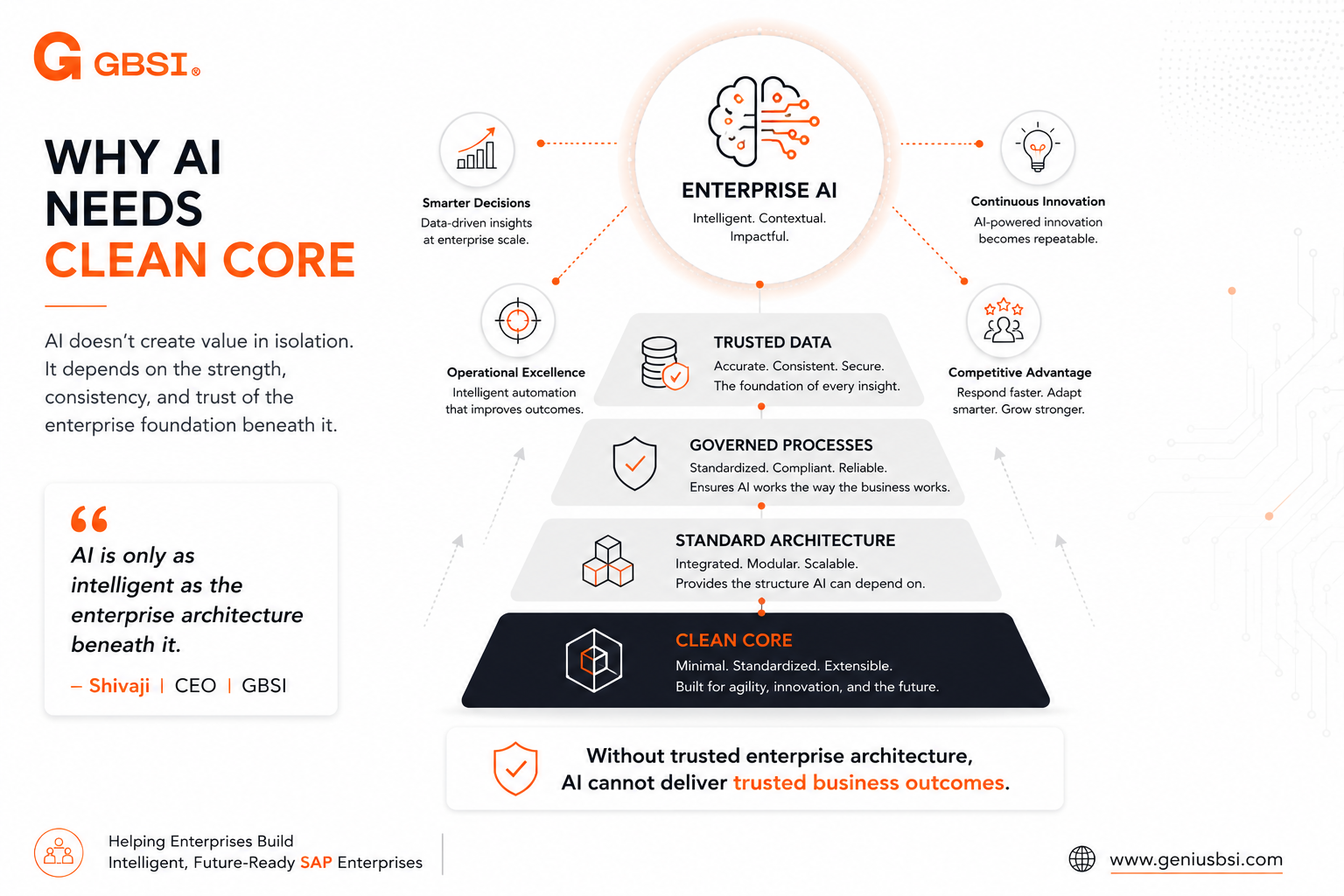
Artificial Intelligence has accelerated the importance of Clean Core in ways many organizations are only beginning to appreciate.
AI depends on consistency.
It depends on governed business processes.
It depends on trusted enterprise data.
It depends on standardized workflows.
Without those elements, even the most advanced AI models struggle to generate reliable business outcomes.
Many organizations are investing heavily in AI while continuing to operate highly customized ERP environments filled with fragmented processes and inconsistent data models.
That creates an unavoidable contradiction.
Organizations cannot expect intelligent automation to emerge from disconnected business foundations.
The quality of AI will increasingly depend on the quality of enterprise architecture beneath it.
In many ways, Clean Core is becoming the prerequisite for Enterprise AI.
The Future Belongs to Composable Enterprises
One of the most significant shifts happening across enterprise technology is the move toward composable business architecture.
Organizations no longer want monolithic transformation programs every decade.
They want the ability to evolve continuously.
They want to introduce new capabilities without disrupting existing operations.
They want cloud innovations to become available immediately—not years later.
They want AI agents, analytics platforms, automation tools, and industry solutions to work together without extensive redevelopment.
That level of flexibility becomes possible only when the ERP foundation remains stable, standardized, and extensible through modern architectural principles.
Clean Core is what enables composability.
It transforms ERP from being a constraint into becoming an innovation platform.
Leadership Should Measure Business Outcomes—Not Custom Objects
One of the biggest mistakes organizations make is treating Clean Core as an IT KPI.
They measure reduced custom objects.
They measure upgrade effort.
They measure code quality.
While these metrics matter, executives should be asking different questions.
Can we integrate acquisitions faster?
Can we launch new business models more quickly?
Can we adopt SAP innovations without major redevelopment?
Can AI operate on trusted enterprise data?
Can our organization respond to market disruption with confidence?
These are business questions.
And increasingly, Clean Core provides the foundation that determines the answer.
Technology architecture is becoming inseparable from business strategy.
Clean Core Requires Organizational Discipline, Not Just Technical Governance
Technology alone cannot create a Clean Core.
Successful organizations establish governance models that encourage standardization before customization.
They evaluate whether every requested enhancement creates long-term strategic value.
They prioritize business process harmonization over department-specific optimization.
Most importantly, they recognize that every customization represents a future decision—not simply a current solution.
This requires leadership discipline.
The question shifts from "Can we customize SAP?" to "Should we?"
That single mindset change influences the future agility of the enterprise far more than any individual technology decision.
The Next Generation of Enterprise Leaders Will Think Differently
The conversation around ERP is changing.
For years, success was measured by implementation milestones, project timelines, and system availability.
Tomorrow, success will be measured by adaptability.
Can the organization integrate new acquisitions quickly?
Can it embrace AI without rebuilding core processes?
Can it respond to regulatory change without months of redevelopment?
Can innovation become continuous rather than episodic?
These questions extend far beyond IT.
They define competitive strategy.
That is why Clean Core deserves a permanent place in executive boardroom discussions.
Not because it simplifies technology.
Because it strengthens the business.
Final Perspective
Every generation of enterprise technology introduces a concept that appears technical at first but ultimately reshapes how businesses compete.
Cloud computing did.
Data platforms did.
Artificial Intelligence is doing it now.
Clean Core belongs in that same category.
Organizations that view it as an infrastructure project will certainly build cleaner ERP environments.
Organizations that recognize it as a business strategy will build enterprises that are faster, more resilient, AI-ready, and prepared for continuous innovation.
In the years ahead, competitive advantage will not belong to companies with the most customized ERP systems.
It will belong to those with the cleanest digital foundation—one capable of supporting whatever the future demands.
Because Clean Core isn't simply about keeping SAP clean.
It's about keeping the business ready for what's next.