Introduction: Why This Comparison Still Trips Up Enterprises
SAP HCM and SAP SuccessFactors often appear on the same shortlist — and for good reason. Both are mature, enterprise-grade HR platforms. Both integrate with SAP ERP and S/4HANA. Both are trusted by large organizations globally.
Yet many SAP HR programs that “choose correctly” on paper still struggle after go-live.
Not because the tools are wrong —
but because the decision logic behind the choice was incomplete.
At GBSI, we see this pattern repeatedly:
- HR systems go live successfully
- Payroll runs
- Talent modules are configured
And yet, confidence erodes within 12–24 months due to:
- Integration friction
- Governance gaps
- Audit findings
- Reporting inconsistencies
- Unclear ownership between HR, IT, and Finance
This article goes beyond feature checklists.
We’ll explain where SAP HCM vs SuccessFactors truly differ, what risks each introduces, and how executives should choose based on operational defensibility — not hype.
Two HR Platforms, Two Operating Philosophies
SAP HCM: Control-First, Payroll-Anchored HR
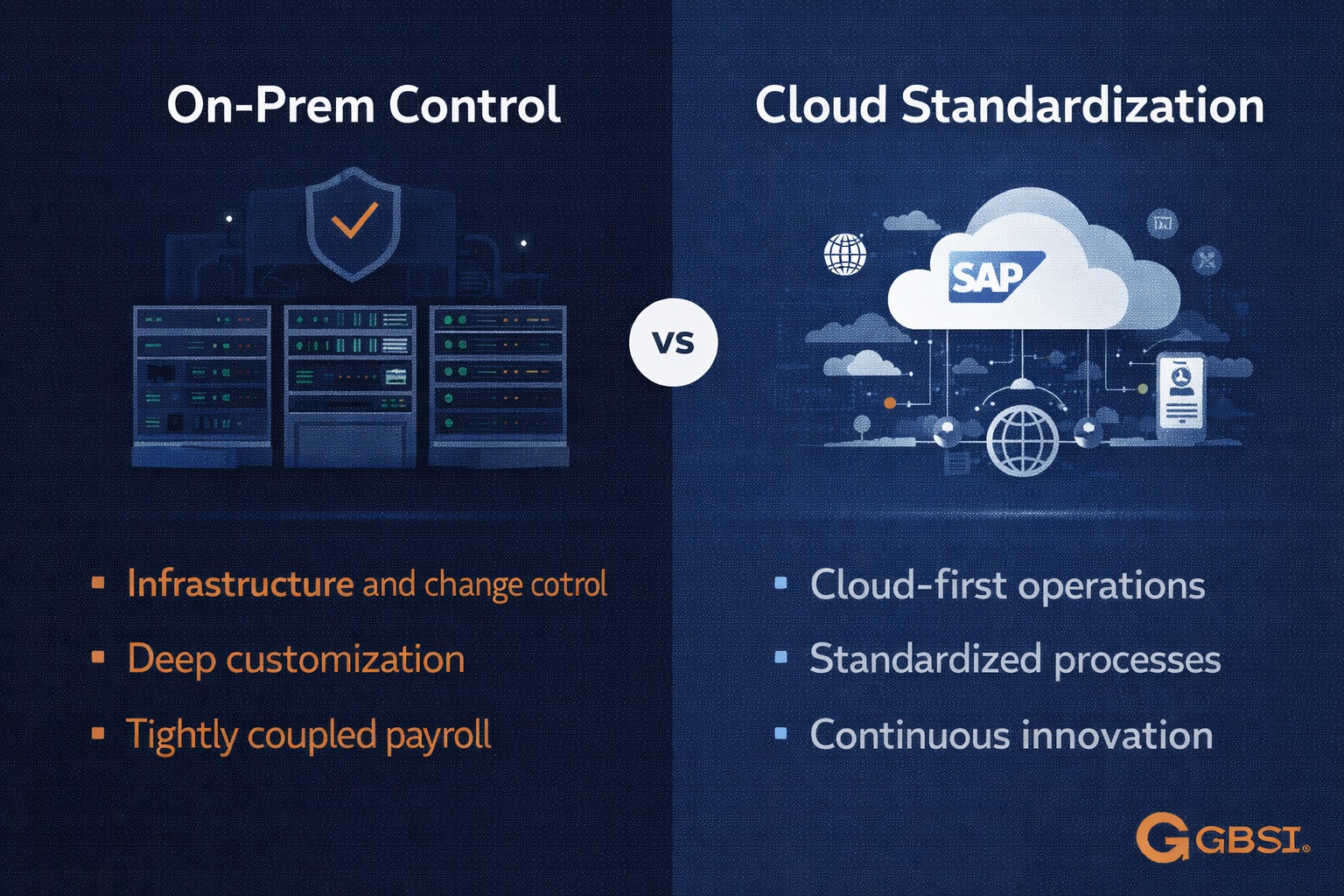
SAP Human Capital Management (SAP HCM) is SAP’s long-standing on-premises HR platform. It remains deeply embedded in enterprises where payroll accuracy, audit control, and system stability are non-negotiable.
SAP HCM is typically favored when organizations prioritize:
- Tight control over payroll cycles
- Deep configuration and customization
- Stable, long-running HR operations
- Clear IT and Basis ownership
With SAP HCM for S/4HANA (H4S4), organizations can now run this familiar HR core on SAP S/4HANA infrastructure — extending support life while preserving proven payroll logic.
GBSI insight: SAP HCM is rarely the risk. The risk is underestimating how tightly payroll, data, and reporting are coupled to it.
SAP SuccessFactors: Cloud-First, Experience-Driven HR
SAP SuccessFactors is SAP’s cloud SaaS HR suite, designed for continuous innovation, global scale, and a modern employee experience.
Organizations typically choose SuccessFactors when they want:
- Faster access to new HR capabilities
- Standardized global HR processes
- Strong talent management and analytics
- Reduced infrastructure ownership
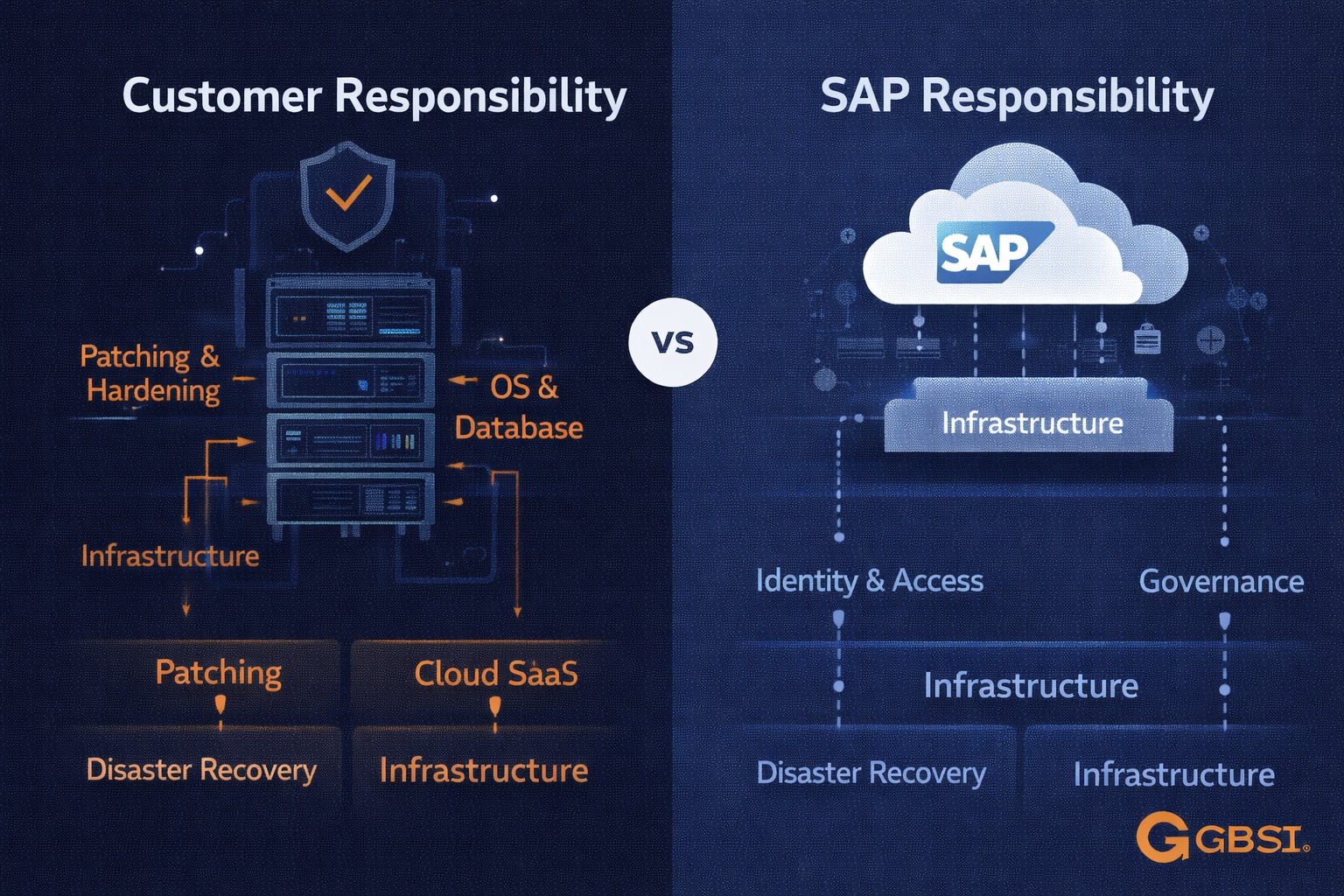
SAP operates the platform, delivers regular releases, and manages availability — shifting the customer’s focus from infrastructure to governance, integration, and adoption.
GBSI insight: SuccessFactors accelerates change — which makes weak governance visible faster.
Why Enterprises Are Re-Evaluating SAP HCM vs SuccessFactors Now
This is no longer a “cloud vs on-prem” debate. It’s driven by converging pressures:
- S/4HANA timelines and ECC support deadlines
- Audit scrutiny on payroll, access, and data integrity
- Employee expectations for modern HR experiences
- CFO demand for defensible ROI from SAP investments
SAP’s maintenance timelines amplify the urgency:
- Mainstream ECC maintenance through 2027
- Extended maintenance through 2030 (at additional cost)
- S/4HANA-based HR options supported well beyond that
For HR leaders, the real risk is drifting into 2027 without:
- A clear HR system of record strategy
- Defined integration ownership
- Governance that survives leadership turnover
Executive takeaway:
SAP HCM offers control with responsibility.
SuccessFactors offers speed with dependency on governance maturity.
Core HR & Payroll: Where Risk Concentrates
Payroll is where SAP HR decisions become non-negotiable.
GBSI insight:
Payroll stability is rarely the issue.
Governance around payroll decisions is.
For payroll-heavy organizations, H4S4 is often the safest continuity path — preserving validated payroll logic while extending platform support.
Talent & Employee Experience: Where SuccessFactors Leads
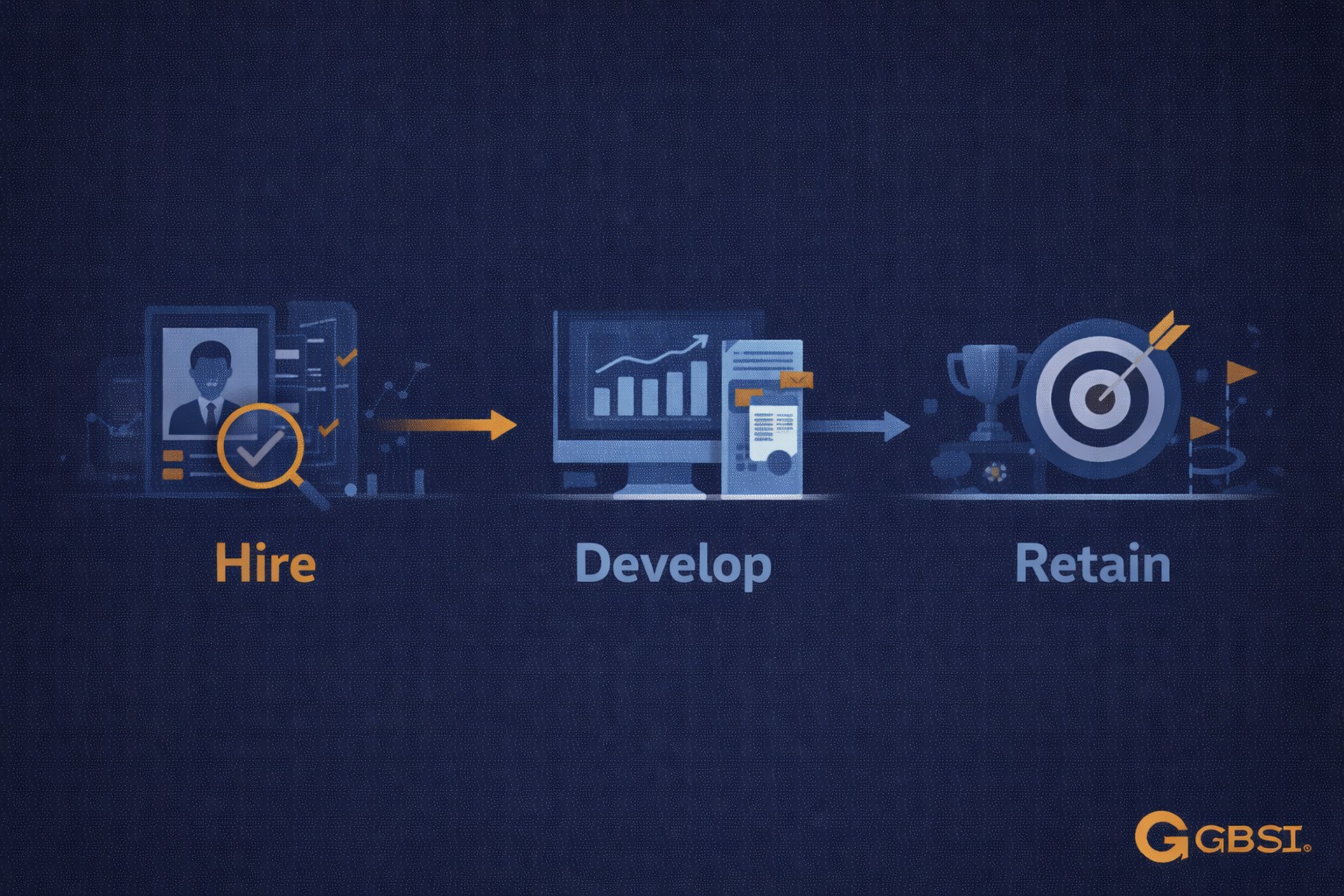
SuccessFactors consistently outperforms SAP HCM in:
- Recruiting & onboarding
- Performance management
- Learning & compliance training
- Succession planning
- Workforce analytics
These areas benefit most from:
- Cloud UX
- Standardized workflows
- Continuous innovation
SAP HCM can support parts of this — but often through custom extensions or third-party tools that introduce long-term complexity.
Integration Reality: HR Never Lives Alone
Both platforms integrate with:
- SAP S/4HANA
- Finance
- Identity & access management
- Analytics platforms
Key difference:
- SAP HCM integrations are often legacy-stable but rigid
- SuccessFactors integrations are flexible but governance-heavy
SAP Integration Suite (on SAP BTP) becomes critical for:
- Avoiding point-to-point interfaces
- Managing change over time
- Preserving data consistency
GBSI insight:
Integration failures rarely show up at go-live.
They show up during audits, acquisitions, and leadership change.
Total Cost of Ownership: What Finance Actually Feels
Truth:
SuccessFactors is often more predictable, not necessarily cheaper.
SAP HCM is often cheaper short-term, riskier long-term.
Which Should You Choose? A Decision Framework
SAP HCM Is Usually Right If:
- Payroll complexity is extreme
- Audit control is paramount
- You have a strong SAP Basis organization
- Change windows must be tightly controlled
SuccessFactors Is Usually Right If:
- Talent modernization is urgent
- Global standardization is needed
- Cloud-first strategy is non-negotiable
- UX and adoption matter deeply
The Most Common Reality: Hybrid
Many enterprises:
- Retain SAP HCM for payroll
- Deploy SuccessFactors for talent & experience
- Govern integrations deliberately
- Move in phases, not leaps
Conclusion: The Platform Matters Less Than the Decisions Around It
SAP HCM and SAP SuccessFactors are both capable platforms.
What determines success is not:
- Which product you choose
- How fast you implement
But whether:
- Ownership is clear
- Decisions are documented
- Risks are surfaced early
- Governance survives leadership change
GBSI perspective:
SAP doesn’t create HR risk.
It exposes it.