In the past, ERP systems were primarily used to store transactions and maintain records. Today, that role has evolved significantly.
With SAP S/4HANA, organizations are moving from data storage systems to intelligent decision-making platforms. Instead of simply capturing information, ERP systems now actively analyze, trigger, and optimize business processes in real time.
This shift is redefining how enterprises operate — and 2026 is the most critical year to act.
Why 2026 Is a Critical Year for SAP Transformation
The upcoming SAP ECC maintenance deadline in 2027 is pushing organizations to accelerate their transformation journeys.
Delaying migration can result in:
● Limited access to experienced SAP consultants
● Increased implementation costs
● Higher risk of rushed and unstable deployments
Organizations starting now can ensure a structured, low-risk transition to SAP S/4HANA — rather than a last-minute, high-pressure migration.
From ERP Systems to Intelligent Enterprises
Modern SAP S/4HANA environments go beyond traditional ERP.
They enable:
● Real-time analytics across departments
● Automated workflows and decision-making
● Predictive insights for operations and finance
For example, in procurement:
● Systems can detect supplier risks instantly
● Trigger corrective actions automatically
● Improve vendor performance without manual intervention
This is the foundation of an intelligent enterprise — where systems don’t just support operations, they actively drive them.
Why SAP Transformation Must Be Business-Led
One of the biggest mistakes companies make is treating SAP S/4HANA as just a technical upgrade.
True transformation happens only when it solves real business problems such as:
● Lack of supply chain visibility
● Slow financial reporting cycles
● Disconnected data across departments
● Increasing compliance and sustainability requirements
At GBSI, SAP transformation is approached as a business-first strategy, ensuring measurable outcomes — not just system upgrades.
The 5 Key Pillars of SAP S/4HANA Transformation
1. Process Discovery & Optimization
Before transformation, organizations must understand existing inefficiencies. Process analysis helps identify bottlenecks and improvement opportunities.
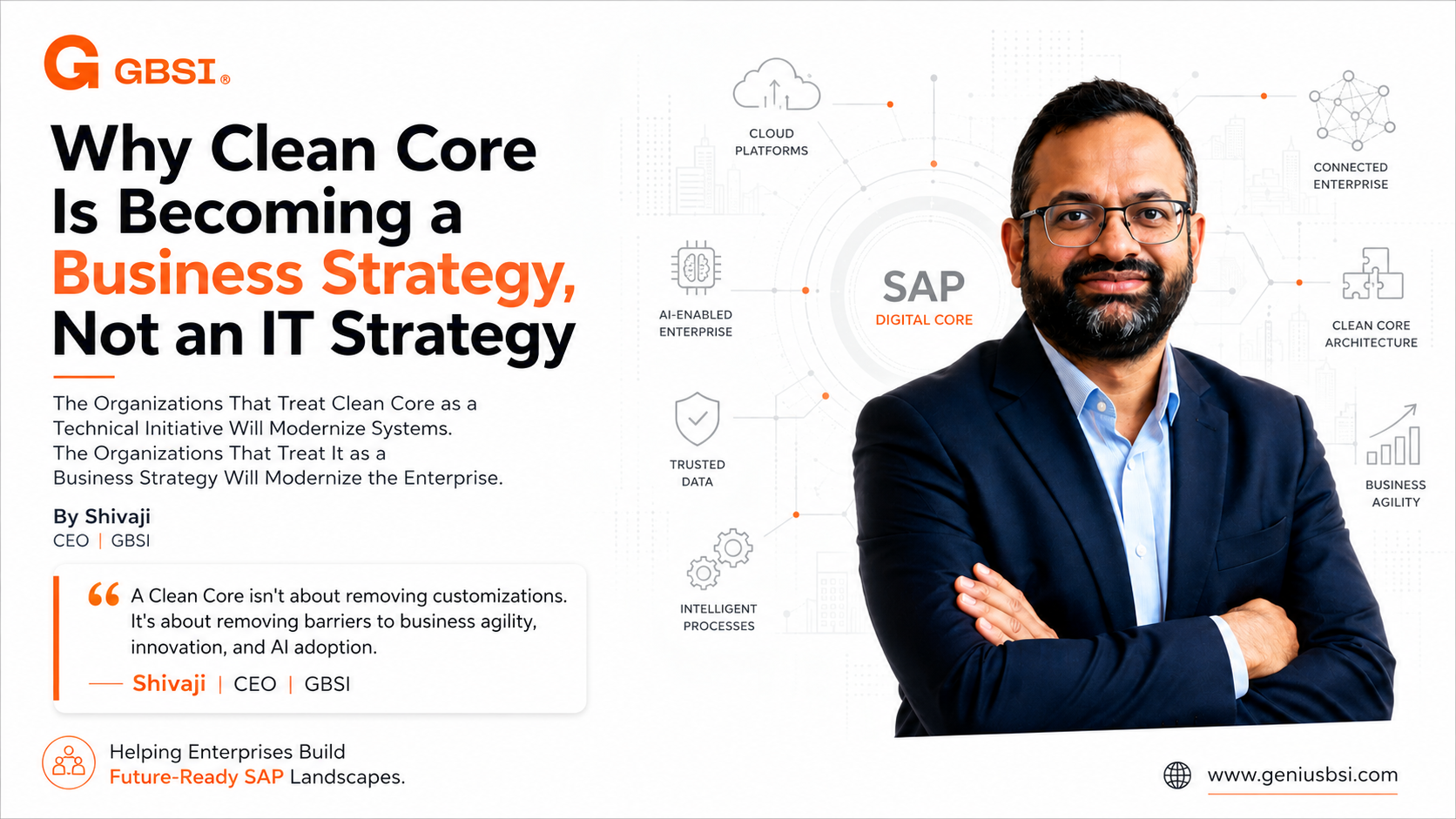
2. Clean Core Strategy
Legacy SAP systems often contain heavy customizations.
A clean core approach:
● Reduces system complexity
● Enables faster upgrades
● Prepares systems for AI and automation
3. Data Governance & Unified Architecture
Accurate data is the backbone of SAP transformation.
Key focus areas:
● Eliminating data silos
● Standardizing data definitions
● Building a single source of truth
4. Intelligent Automation & AI Integration
SAP S/4HANA enables automation across functions such as:
● Finance reconciliation
● Procurement workflows
● Supply chain planning
This reduces manual effort and improves efficiency.
5. Continuous Innovation with SAP BTP
Transformation doesn’t end at go-live.
With SAP Business Technology Platform (BTP), organizations can:
● Build extensions without disrupting core ERP
● Continuously innovate
● Scale new capabilities faster
Why Clean Core Is Essential for AI-Driven Enterprises
AI and automation depend on stable and standardized systems.
Highly customized legacy environments often lead to:
● Data inconsistencies
● Broken workflows
● Unreliable automation outcomes
A clean core ensures:
● Consistent system behavior
● Faster innovation cycles
● Seamless AI integration
This is critical for organizations aiming to scale intelligent operations.
The Human Side of SAP Transformation
Technology alone doesn’t drive transformation — people do.
As automation increases:
● Employees shift from manual tasks to strategic roles
● Finance teams focus on insights instead of reconciliation
● Operations teams focus on optimization instead of execution
Organizations must invest in:
● Training programs
● Change management
● Digital skill development
Without this, transformation efforts often fail to deliver full value.
SAP Transformation Maturity Model
Organizations typically evolve through three stages:
Level 1: Legacy Systems (SAP ECC)
● Manual processes
● Heavy customization
● Limited visibility
Level 2: Digital Core (SAP S/4HANA)
● Real-time data access
● Improved reporting
● Better decision-making
Level 3: Intelligent Enterprise
● Automated workflows
● AI-driven decisions
● Scalable and adaptive systems
The goal is to move beyond reactive operations toward proactive, intelligent decision-making.
Preparing for the Future with SAP S/4HANA
SAP transformation is no longer optional — it’s a strategic necessity.
Organizations that focus on:
● Clean core architecture
● Strong data governance
● Business-driven transformation
will gain a significant competitive advantage.
Those who delay risk:
● Higher costs
● Operational inefficiencies
● Missed innovation opportunities
How GBSI Can Help
At GBSI, we specialize in:
● SAP S/4HANA implementation
● Migration strategy (Greenfield, Brownfield, Hybrid)
● SAP BTP integration
● Process optimization and automation
Our approach ensures: ✔ Faster implementation ✔ Reduced risk ✔ Business-driven outcomes