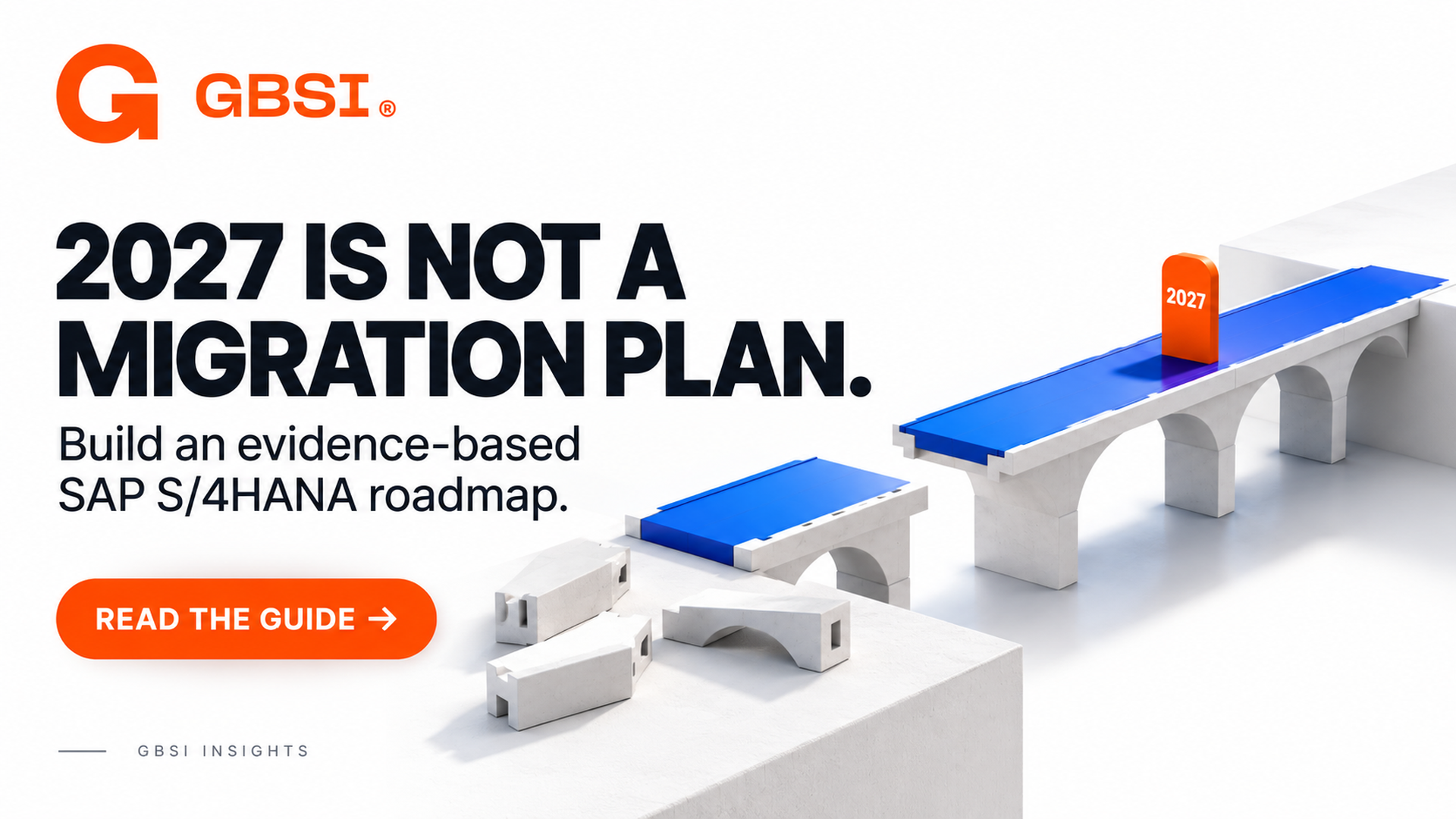
Plan Your SAP Business Suite Transition Before the Critical Path Tightens

SAP states that mainstream maintenance for the core SAP Business Suite 7 applications runs through the end of 2027, with optional extended maintenance through the end of 2030. Your actual scope and support terms need to be confirmed against your landscape and agreements. GBSI helps organizations turn this timing into a coordinated planning program: baseline the current estate, compare transition scenarios, identify custom code and data work, and establish an executable roadmap with owners and decision gates.
Contact Us

Why Choose GBSI

Governance should make responsibilities and evidence clear throughout the solution lifecycle.

Fact-based current state

We inventory applications, processes, integrations, data, customizations, and organizational constraints.

Comparable choices

We frame greenfield, system conversion, and selective approaches against shared business and technical criteria.

Program readiness

We identify critical dependencies, resources, governance, and preparatory work before a migration project starts.

Common SAP 2027 Migration Challenges

Unclear business case

A technology deadline alone does not define business value. We document the outcomes and constraints that should shape the transition.

Unknown custom code

Extensions and interfaces can create hidden effort. We identify remediation, retirement, and clean-core opportunities.

Data decisions delayed

Ownership, quality, history, and migration scope need early agreement. We bring these into the plan.

Competing transition paths

Teams need comparable assumptions for cost, disruption, timing, and future flexibility. We structure scenario decisions.

Resource contention

Business and technology specialists may be unavailable when needed. We sequence decisions and capacity requirements.

No integrated roadmap

Separate workstreams can miss dependencies. We coordinate releases, testing, change, and governance in one view.

Turn the Deadline into a Managed Decision

GBSI assesses the current environment, facilitates target-state choices, and defines a phased preparation and migration roadmap. The output includes scenario assumptions, workstream dependencies, risks, ownership, and the first mobilization tasks. The page links to existing S/4HANA Migration and cloud migration services for execution; it does not repeat those implementation descriptions.

‍

Request a Custom Quote

SAP 2027 Migration Center Services

Landscape baseline

Inventory applications, modules, custom code, data, interfaces, and infrastructure.

Process and business case

Clarify target processes, outcomes, and change implications.

Scenario comparison

Compare transition paths with common assumptions and decision criteria.

Custom code review

Identify remediation, retirement, and extension opportunities.

Data planning

Define quality, ownership, history, and migration scope.

Target architecture

Document deployment, integration, security, and clean-core choices.

Migration roadmap

Sequence workstreams, releases, tests, cutover preparation, and resources.

Program mobilization

Establish governance, risk, decisions, and value tracking.

A Four-Step Migration Planning Approach

Baseline

Baseline the estate.

Compare

Compare scenarios.

Decide

Decide the target path.

Mobilize

Mobilize a coordinated program.

Frequently Asked Questions

Does every SAP customer have the same 2027 deadline?
No. The published Business Suite 7 maintenance dates have product and contract scope; confirm applicability to your environment.
Is optional extended maintenance available?
SAP describes an optional period through 2030 for relevant core applications, subject to its terms.
How is this different from the existing migration page?
This page covers pre-program decisions and mobilization. The live migration pages cover implementation services.
Can we compare deployment options?
Yes. The scenario assessment considers business, technology, cost, and timing assumptions.
What is the first output?
Yes. The scenario assessment considers business, technology, cost, and timing assumptions.