
The Most Important Part of an SAP Implementation Is No Longer the Go-Live
For decades, SAP transformation programs have been judged by familiar milestones. Organizations celebrated successful go-lives, budget adherence, user adoption, and process standardization as indicators of project success. Those measures remain important because they establish the operational foundation every enterprise depends upon. However, I believe Artificial Intelligence is fundamentally changing how organizations should evaluate SAP transformation. The question is no longer whether an ERP implementation is successful. The more strategic question is whether that implementation prepares the enterprise for continuous Business AI innovation.
The recent SAP S/4HANA Public Cloud implementation at Elevate Campuses illustrates this shift remarkably well. On the surface, the announcement highlights the successful migration from a fragmented landscape of on-premises SAP and Tally systems to a unified SAP S/4HANA Public Cloud platform using the GROW with SAP methodology. The implementation delivers a single financial backbone, standardized business processes, stronger governance, real-time visibility, and a platform designed to support future AI capabilities.
Many organizations will see another successful cloud ERP implementation.
I believe they should see something much larger.
The implementation itself is not the story.
The architectural decisions behind it are.
Cloud ERP Is Becoming the Operating System for Enterprise AI
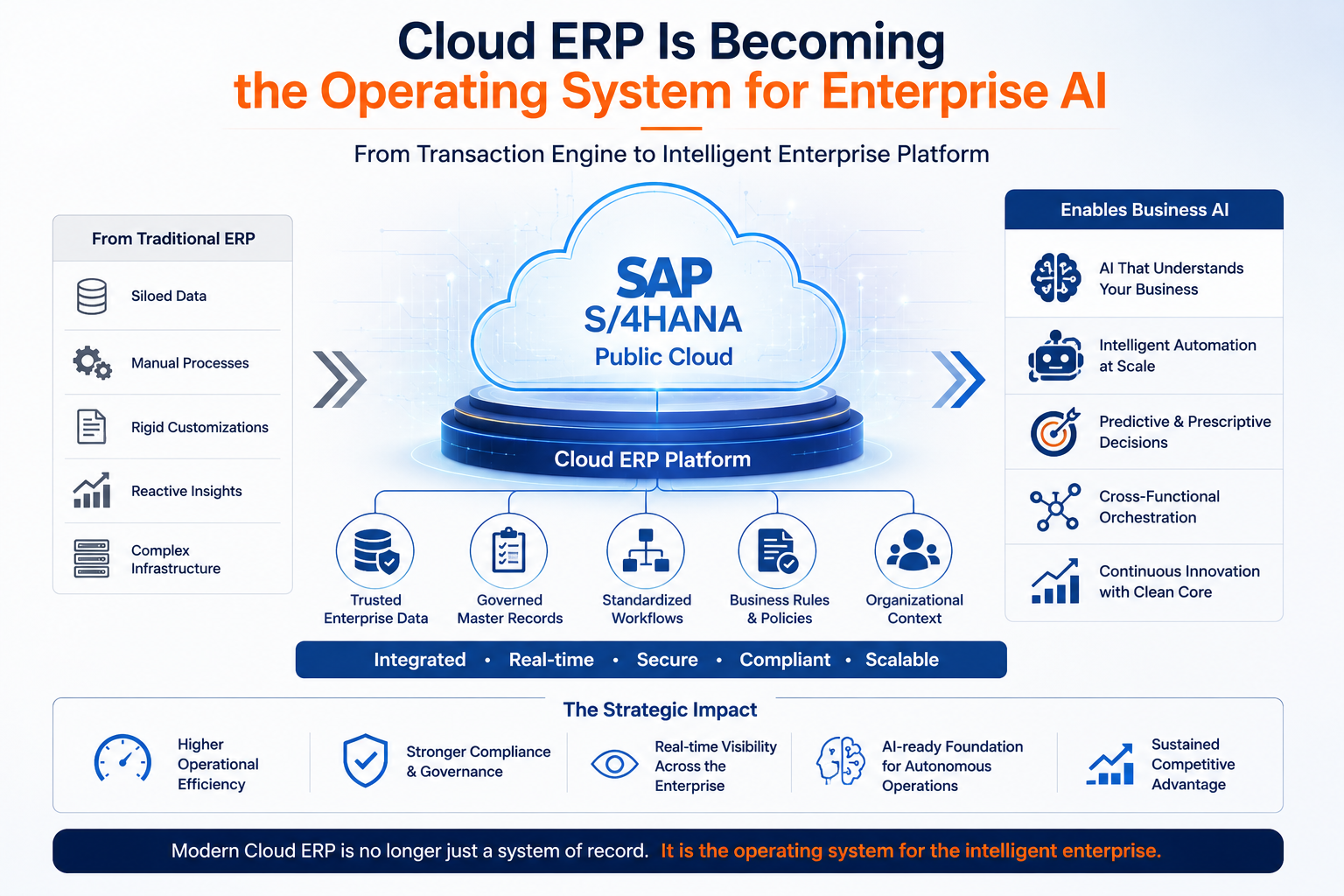
For years, ERP modernization focused on improving efficiency, simplifying operations, strengthening compliance, and integrating business processes. Those objectives remain essential, but they no longer represent the complete business value of ERP. Enterprise AI depends on far more than transactional processing. It requires trusted enterprise data, governed master records, standardized workflows, business rules, and organizational context that intelligent systems can understand consistently across every function.
This fundamentally changes the purpose of Cloud ERP. Instead of serving only as a transaction engine, SAP S/4HANA Public Cloud is increasingly becoming the operational platform that enables Business AI to reason, automate, and orchestrate enterprise-wide decisions. Organizations investing in modern ERP today are not simply replacing legacy technology. They are constructing the digital foundation upon which autonomous business operations will eventually depend.
That is a very different strategic objective.
Why Staying Standard May Become the Biggest Competitive Advantage
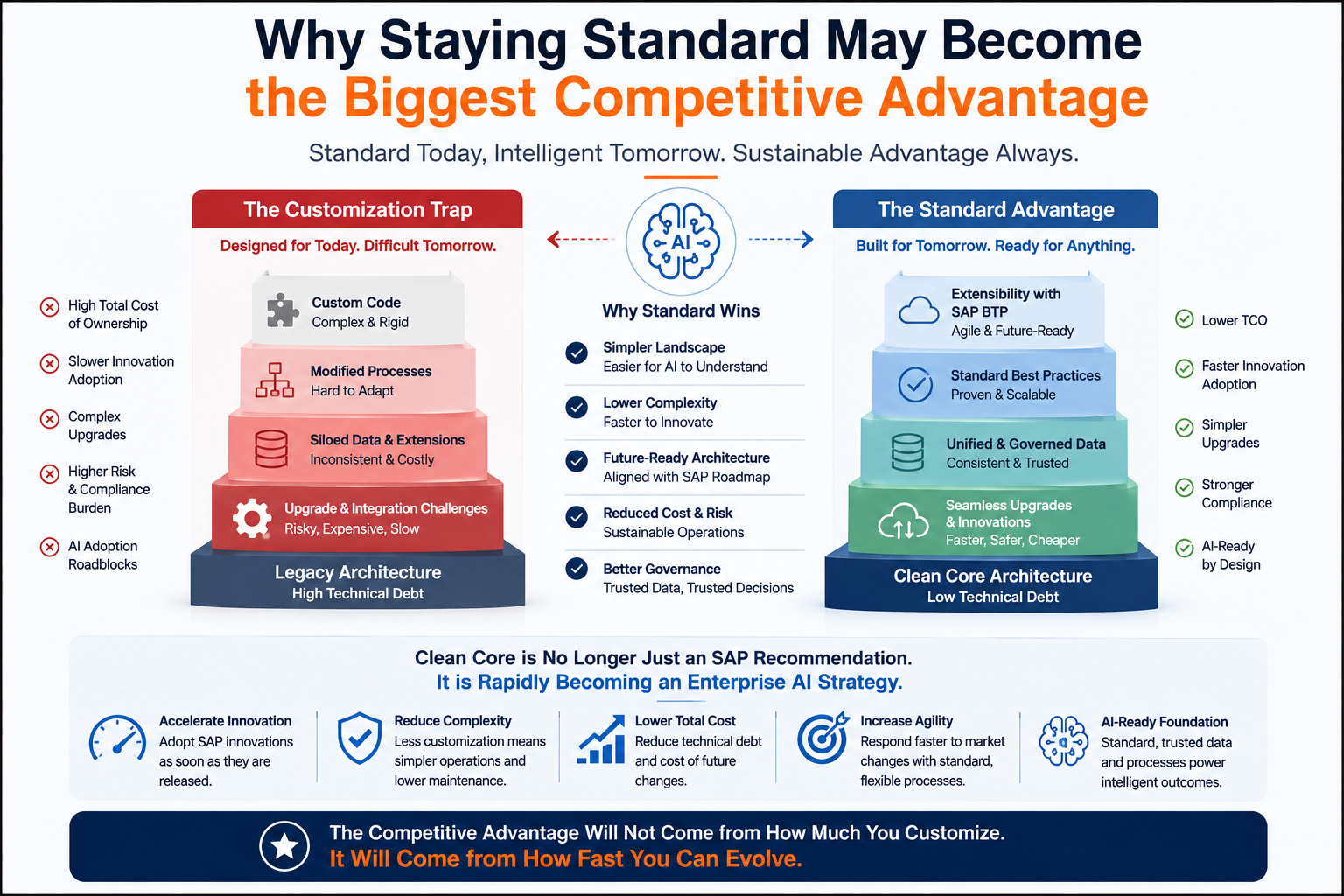
One decision within the Elevate implementation deserves significantly more attention than the migration itself. Rather than redesigning SAP around historical business processes, the organization deliberately adopted SAP's standard best practices through GROW with SAP, creating a standardized and governed cloud ERP landscape.
Historically, customization was often considered a competitive advantage. Organizations invested heavily in tailoring SAP to reflect their unique operating models, approval workflows, and business practices. While these decisions solved immediate operational requirements, they also introduced years of technical complexity that accumulated with every upgrade.
Artificial Intelligence changes the economics of customization.
Every customization becomes another layer that AI must eventually understand, govern, maintain, and continuously optimize. Organizations operating close to SAP standard processes will adopt future innovations significantly faster because their architecture evolves alongside SAP's roadmap. Organizations maintaining highly customized ERP landscapes will increasingly discover that technical debt slows AI adoption just as much as it once slowed digital transformation.
I believe Clean Core is no longer simply an SAP recommendation.
It is rapidly becoming an Enterprise AI strategy.
Enterprise Architecture Is Quietly Becoming the Enterprise Intelligence Layer
One of the biggest misconceptions surrounding Enterprise AI is that success will primarily depend on selecting the most powerful AI model. Over the past two years, enterprise conversations have focused heavily on foundation models, copilots, intelligent agents, and generative AI capabilities. While these technologies will continue evolving, I believe they are not where long-term competitive advantage will be created.
The real differentiator is Enterprise Architecture.
Traditional Enterprise Architecture connected applications, data, integrations, and infrastructure. Business AI expands that responsibility dramatically. Enterprise Architecture must now connect business knowledge, enterprise context, governance policies, operational metadata, organizational relationships, and process intelligence into a trusted environment where AI can make decisions responsibly.
In many ways, Enterprise Architecture is evolving beyond technology governance.
It is becoming the intelligence layer of the enterprise.
The AI-Ready Enterprise Architecture Model
Based on the direction of modern SAP transformations, I believe successful Enterprise AI will increasingly depend on five interconnected architectural layers.
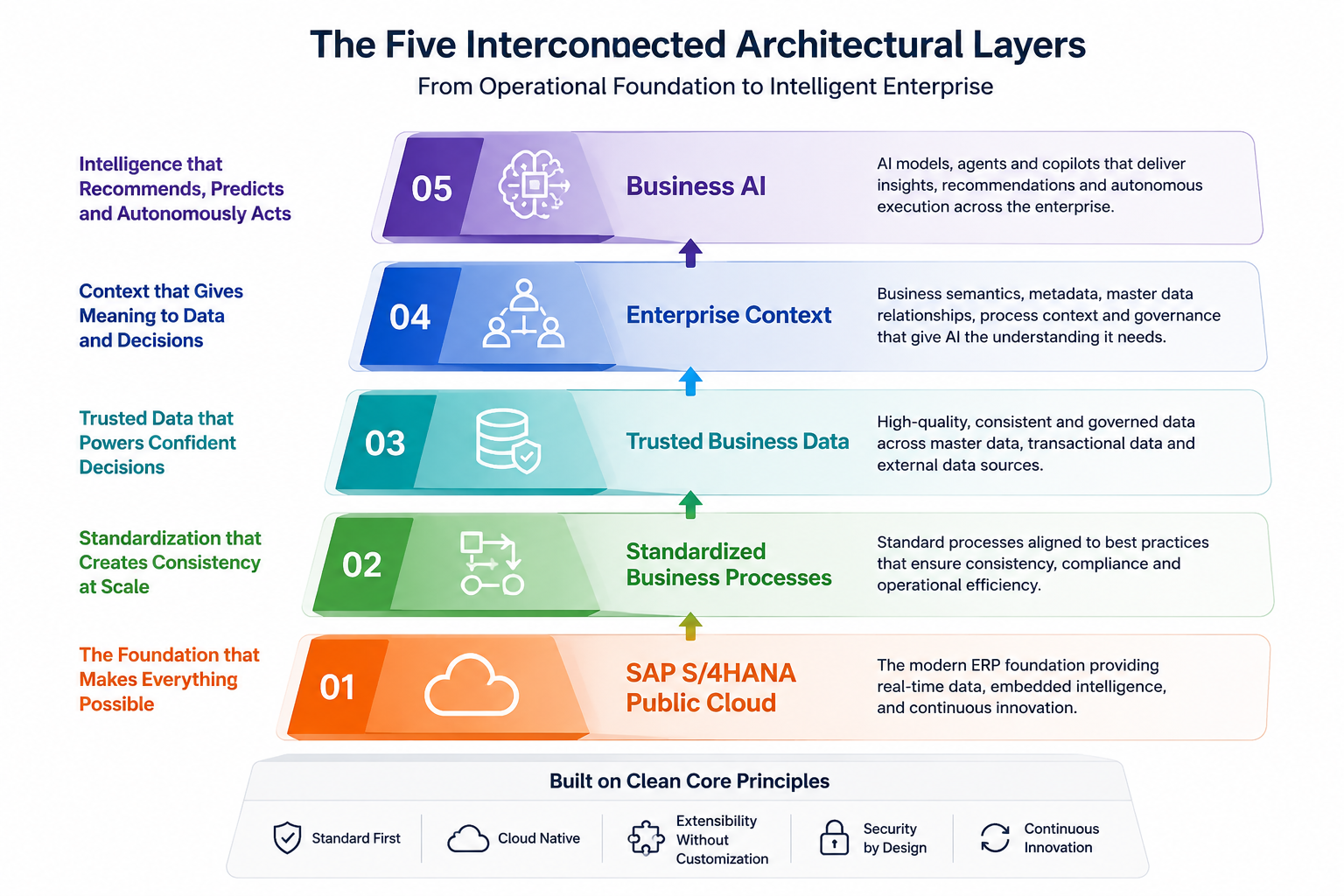
Many organizations begin their AI strategy at the top of this model.
Successful organizations begin at the bottom.
Business AI cannot consistently deliver trusted recommendations without enterprise context. Enterprise context depends upon trusted business data. Trusted data depends upon standardized business processes. Standardized processes ultimately depend upon a modern ERP platform capable of continuous innovation.
This architectural progression explains why ERP modernization is becoming one of the most important AI investments an organization can make.
The Real Transformation Begins After Go-Live
Another aspect of the Elevate announcement deserves attention. The implementation roadmap extends well beyond ERP deployment and includes Group Reporting, Project Systems, and the progressive adoption of SAP's embedded AI capabilities.
I believe this sequence represents the future of SAP transformation.
Implementation establishes the digital foundation.
Standardization creates operational consistency.
Enterprise Architecture enables scalability.
Business AI delivers intelligent execution.
Organizations attempting to introduce AI before completing these foundational stages frequently encounter inconsistent data, fragmented governance, disconnected processes, and limited trust in AI-generated recommendations. AI should not be viewed as the first milestone of transformation. It should become the natural outcome of successful Enterprise Architecture.
My Perspective
When I read the Elevate Campuses announcement, I did not simply see another successful SAP S/4HANA Public Cloud implementation. I saw evidence of a broader transformation taking place across the SAP ecosystem.
Cloud ERP is no longer being implemented simply to modernize finance or reduce infrastructure costs. It is becoming the enterprise foundation that enables Business AI, intelligent automation, and continuous innovation. Organizations that invest today in Clean Core, standardized business processes, trusted enterprise data, and disciplined Enterprise Architecture will be significantly better positioned to adopt future SAP innovations than those continuing to build complexity into their ERP landscapes.
At GBSI, we believe successful SAP transformation is no longer measured by implementation timelines or successful go-lives alone. Its long-term value is determined by how effectively today's Enterprise Architecture enables tomorrow's Enterprise AI.
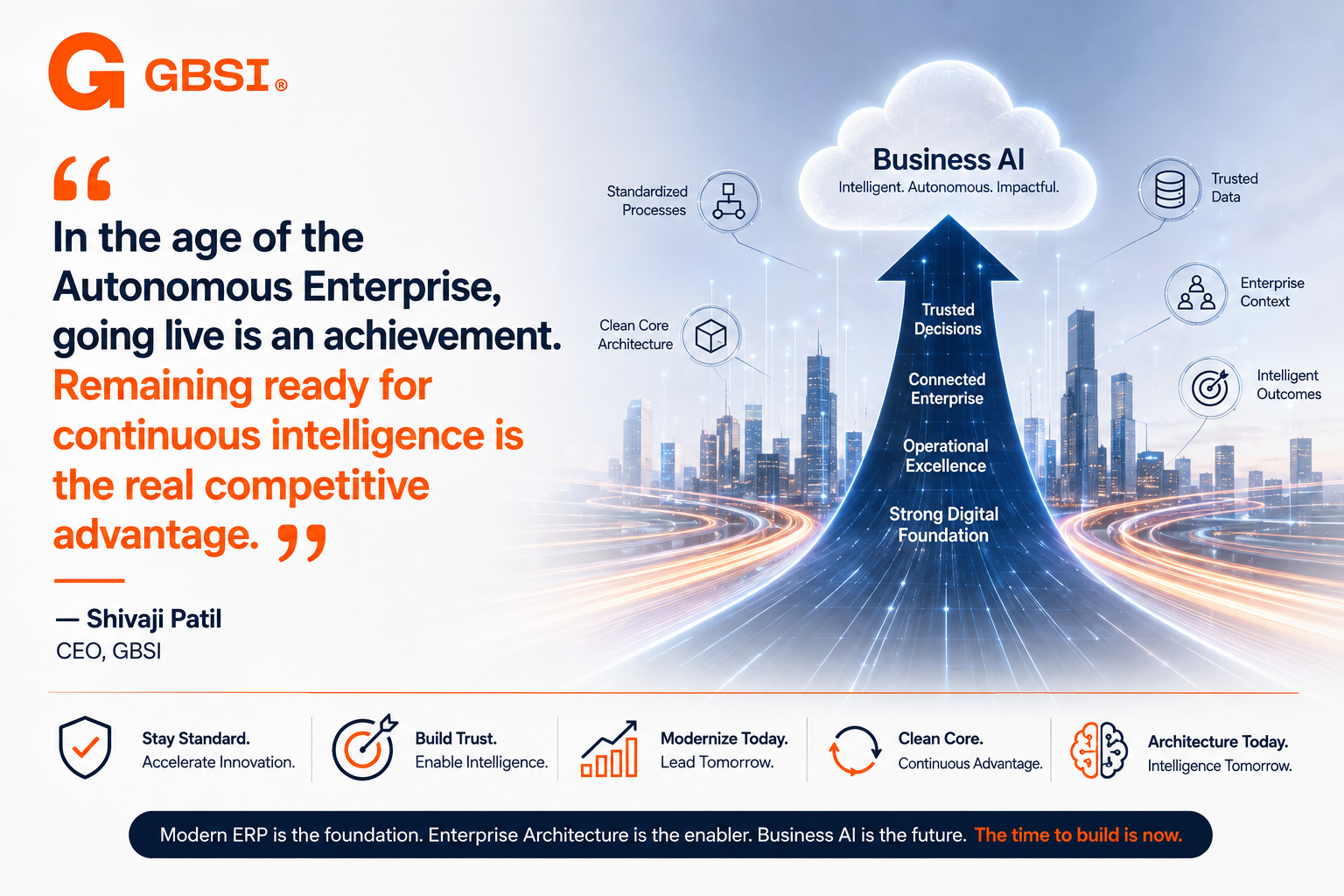
Because in the age of the Autonomous Enterprise, going live is an achievement. Remaining ready for continuous intelligence is the real competitive advantage.
Reference
This article reflects the author's perspective on the recent ETCIO report covering Elevate Campuses' SAP S/4HANA Public Cloud implementation, including its adoption of GROW with SAP, a unified finance platform, standardized processes, and an AI-ready roadmap featuring Group Reporting, Project Systems, and embedded SAP AI capabilities.