Introduction
Over the past two years, Artificial Intelligence has become one of the most significant priorities in boardrooms around the world.
Organizations across every industry have invested heavily in AI platforms, advanced analytics, intelligent automation, digital assistants, and generative AI technologies. Executive teams continue to explore new use cases while technology vendors compete to demonstrate increasingly sophisticated AI capabilities.
Despite this momentum, many organizations continue to face a common challenge.
They are generating more insights than ever before, yet they are not necessarily making better decisions.
This challenge is becoming increasingly visible across supply chain operations, manufacturing environments, procurement organizations, finance teams, customer service functions, and enterprise planning processes.
The issue is not a lack of data.
The issue is not a lack of AI.
The issue is that most organizations are still structured around reporting and analysis rather than decision-making.
As a result, many businesses find themselves overwhelmed with information while struggling to convert that information into meaningful action.
Recent discussions emerging from SAP Sapphire 2026 suggest that a new operating model is beginning to take shape.
I believe the next generation of enterprise leaders will build what I call the Decision-Centric Enterprise.
The Traditional Enterprise Was Designed Around Information
For decades, organizations have invested in systems designed to collect, process, and report information.
ERP platforms captured transactions.
Business intelligence platforms generated dashboards.
Analytics tools provided visibility into performance metrics.
Data warehouses centralized information.
These investments delivered tremendous value.
They improved operational transparency and enabled leaders to monitor business performance more effectively.
However, visibility alone does not create competitive advantage.
Competitive advantage comes from making better decisions faster than competitors.
This distinction is becoming increasingly important as business environments grow more complex and unpredictable.
Organizations now operate in a world characterized by supply chain disruptions, labor shortages, economic uncertainty, changing customer expectations, geopolitical risks, and accelerating technological change.
In this environment, simply knowing what happened is no longer sufficient.
Organizations must be able to determine what should happen next.
Why AI Is Exposing a Decision-Making Gap
Artificial Intelligence has highlighted a challenge that has existed for many years.
Most organizations possess significant amounts of data.
Many have invested heavily in analytics.
Yet relatively few have developed a systematic approach to decision-making.
Executives often receive hundreds of reports, dashboards, alerts, and performance indicators.
The volume of information continues to increase.
What often remains unclear is which actions should be prioritized and how decisions should be executed across the enterprise.
This is where many AI initiatives begin to encounter limitations.
AI can generate insights.
AI can identify patterns.
AI can analyze vast amounts of information.
However, unless organizations establish a framework that connects insights to business decisions, the value of AI remains constrained.
The next stage of enterprise transformation will therefore focus less on generating information and more on improving decision quality.
The Emergence of the Decision-Centric Enterprise
The most forward-thinking organizations are beginning to shift their focus away from information management and toward decision management.
This represents a fundamental change in operating philosophy.
A Decision-Centric Enterprise is designed around the principle that every process, system, workflow, and technology investment should ultimately support faster, more informed, and more consistent business decisions.
Rather than measuring success solely through operational efficiency, these organizations focus on improving decision velocity, decision quality, and decision confidence.
This shift changes how organizations think about technology investments.
The objective is no longer simply to collect more data.
The objective is to create an environment where data, processes, governance, and AI work together to support intelligent decision-making.
Why Business Context Is Becoming More Valuable Than Data
One of the most important lessons emerging from enterprise AI initiatives is that data alone is not enough.
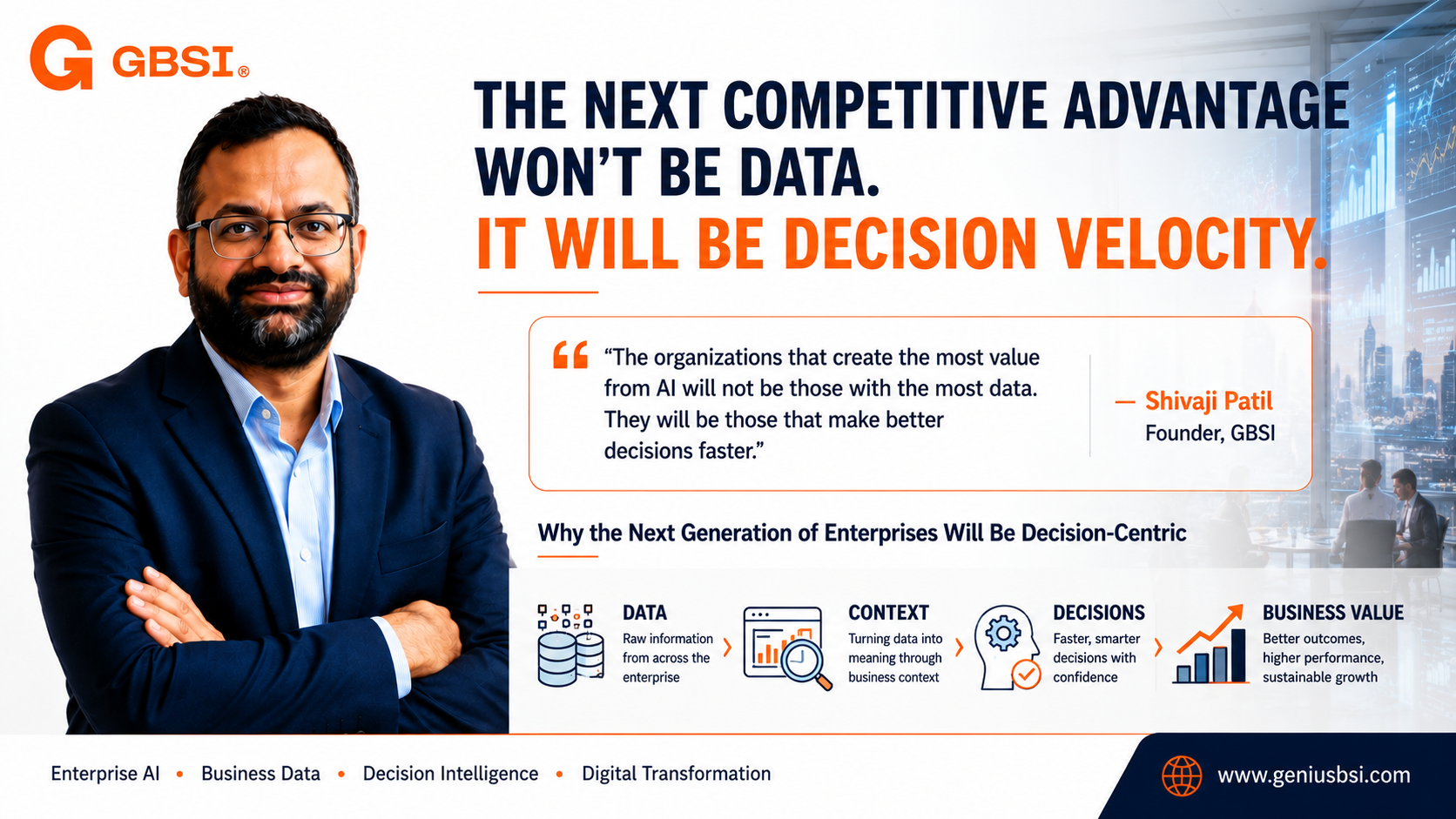
Organizations increasingly recognize that business context is what transforms information into action.
Business context includes:
- Process intelligence
- Organizational structures
- Operational priorities
- Governance frameworks
- Customer relationships
- Financial rules
- Supply chain dependencies
Without context, AI can generate recommendations.
With context, AI can support decisions.
This distinction explains why technologies such as SAP Business Data Cloud, SAP Business AI, SAP Joule, SAP Integrated Business Planning, and SAP Business Technology Platform are receiving significant attention.
These technologies are not simply managing data.
They are helping organizations create the business context required for intelligent decision-making.
The Future Enterprise Will Compete on Decision Velocity
Historically, organizations competed based on scale, cost efficiency, operational excellence, or market reach.
While these factors remain important, decision velocity is emerging as a new source of competitive advantage.
Organizations that can identify change faster, evaluate options more effectively, and execute decisions more quickly will be better positioned to respond to market opportunities and business risks.
This capability becomes particularly important in areas such as:
- Supply Chain Management
- Manufacturing Operations
- Procurement
- Workforce Planning
- Customer Experience
- Financial Planning
- Risk Management
The organizations that thrive in the next decade will not necessarily be those with the most data.
They will be those that can transform information into action more effectively than their competitors.
What This Means for Business Leaders
Business leaders should begin asking different questions.
Rather than asking whether the organization has enough data, they should ask whether their teams can consistently make high-quality decisions.
Rather than focusing solely on AI adoption, they should focus on creating the governance, process intelligence, and business context required to support AI at scale.
Most importantly, organizations should recognize that AI is not replacing decision-making.
AI is elevating the importance of decision-making.
The companies that build decision-centric operating models today will be better positioned to create value from AI tomorrow.
Final Thoughts
The next phase of enterprise transformation will not be defined by how much data organizations collect or how many AI tools they deploy.
It will be defined by how effectively they make decisions.
As AI continues to reshape the business landscape, organizations must move beyond information-centric operating models and begin building decision-centric enterprises.
The organizations that successfully make this transition will not only create greater value from AI investments.
They will establish a foundation for long-term resilience, agility, and growth in an increasingly complex business environment.
Source
Turning Insight into Impact – SAP Executive Perspectives on AI, Planning, and Decision-Centric Operations
https://www.sap.com/blogs/turning-insight-into-impact/