AI in SAP EWM: How Intelligent Warehousing Is Transforming Supply Chain Operations
Modern warehouses powered by SAP Extended Warehouse Management (SAP EWM) already operate with optimized processes. Task creation, replenishment triggers, and queue prioritization are typically controlled through predefined rules.
However, even in highly optimized warehouses, thousands of micro-decisions occur every day—from determining task priority to predicting workload spikes and identifying congestion areas.
Rule-based systems react after an event occurs. Artificial Intelligence (AI) enables warehouses to anticipate events before they disrupt operations.
This article explains how AI enhances SAP EWM with predictive intelligence, explores high-impact use cases, and outlines what organizations must prepare before implementing AI-driven warehouse automation.
How AI Transforms Decision-Making in SAP EWM
Traditional SAP EWM processes operate on event-driven logic.
For example:
- Goods receipt posting creates warehouse tasks
- Replenishment triggers when minimum stock levels are reached
- Queue priorities are predefined in system configuration
These processes are stable and transparent—but they are static.
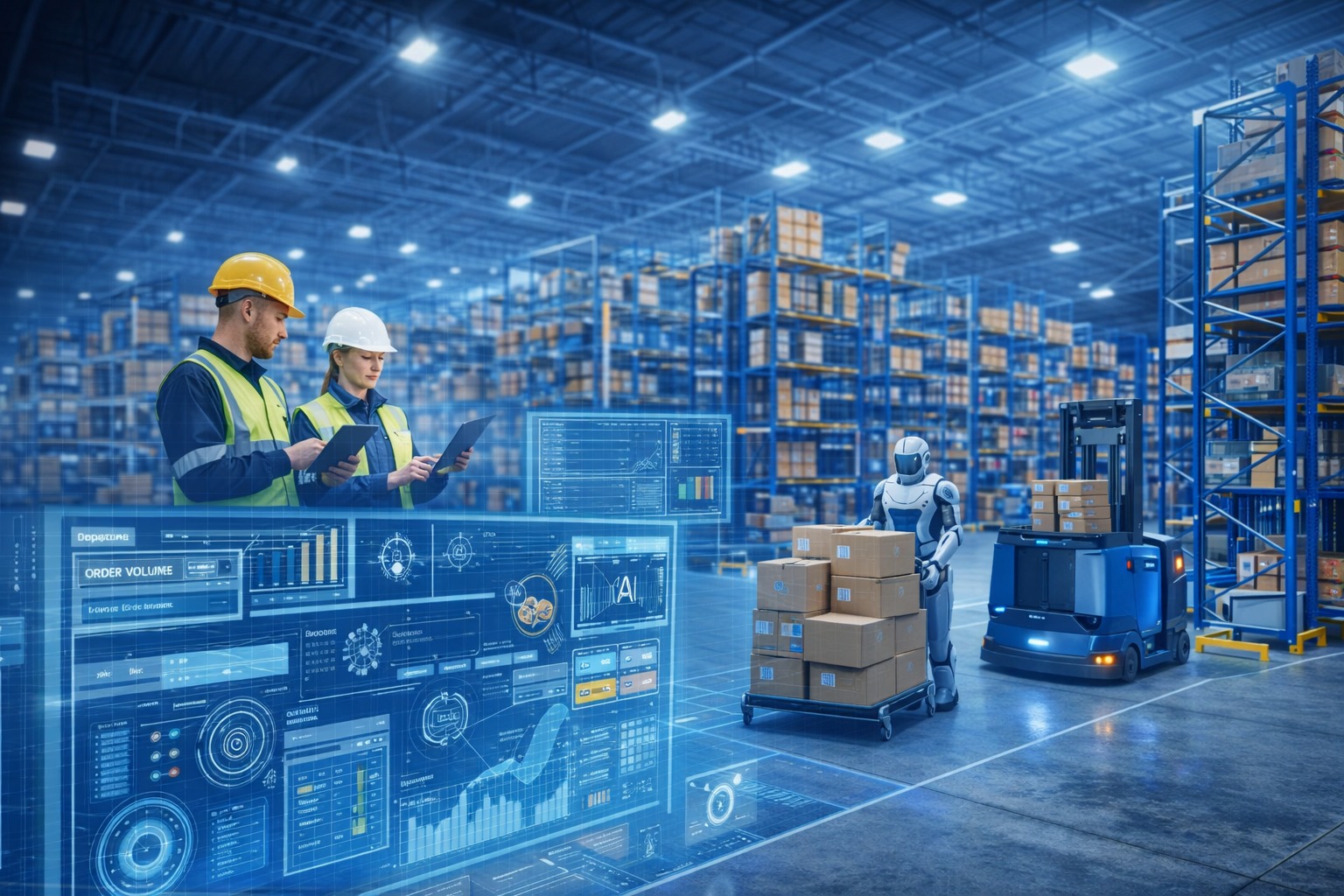
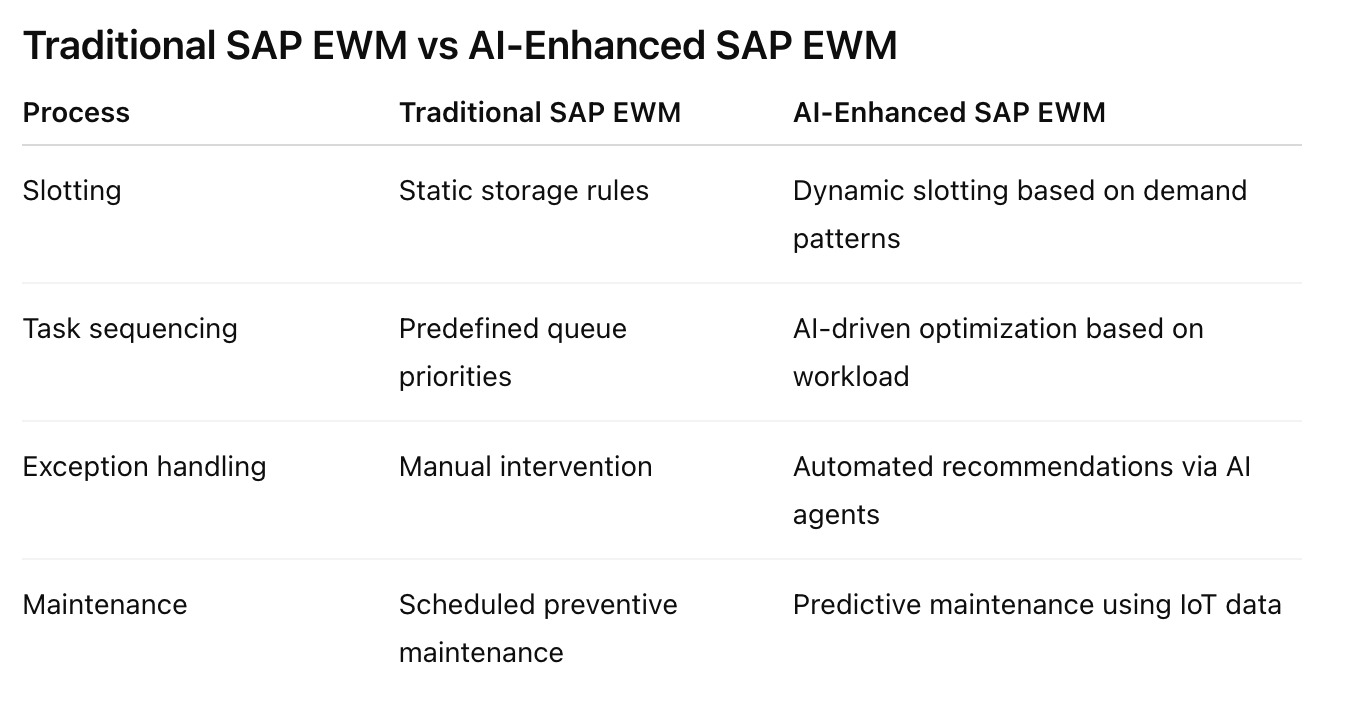
AI introduces predictive and adaptive decision-making by analyzing historical and real-time warehouse data.
AI models can evaluate:
- Historical picking data
- Warehouse order volumes
- Inventory movement patterns
- Labor performance metrics
- Exception logs
Based on this data, AI can predict operational scenarios such as:
- Upcoming order volume spikes
- Potential stock shortages
- Congestion in specific warehouse zones
- Labor demand for upcoming shifts
Instead of reacting to problems, SAP EWM systems enhanced with AI proactively adjust operations.
Key AI Use Cases in SAP EWM
The real value of AI in SAP EWM comes from improving operational decisions that occur continuously across the warehouse.
Three areas deliver the highest impact.
1. Predictive Slotting and Intelligent Product Placement
Slotting determines where products are stored within the warehouse.
Traditional slotting in SAP EWM relies on factors such as:
- Product size and weight
- Storage type
- Movement classification (ABC analysis)
However, these rules do not adapt quickly when order patterns or seasonal demand changes.
AI models can analyze:
- Order history
- Item co-occurrence patterns
- Picking frequency
- Seasonal demand variations
Based on these insights, the system can recommend:
- Moving high-velocity items closer to packing stations
- Grouping items frequently purchased together
- Reorganizing storage zones to reduce picker travel distance
These recommendations can then trigger standard SAP EWM rearrangement tasks.
Operational impact
- Reduced picker travel distance
- Faster order fulfillment
- Lower labor costs per shipment
2. AI-Driven Labor Planning and Demand Forecasting
Warehouse staffing is often planned using historical averages and manual estimates.
In environments such as eCommerce or omnichannel retail, demand patterns can change rapidly.
Machine learning models can forecast upcoming workload by analyzing:
- Historical order volumes
- Promotion schedules
- Seasonal sales trends
- Inbound and outbound shipment data
This allows planners to forecast workload across activities such as:
- Picking
- Packing
- Staging
- Loading
With this information, operations teams can:
- Adjust shift schedules early
- Allocate resources efficiently
- Reduce overtime costs
Operational impact
- More stable warehouse throughput
- Improved service-level performance
- Better workforce utilization

3. Computer Vision for Goods Receipt and Inventory Accuracy
Goods receipt processes often generate inventory discrepancies due to:
- Manual counting errors
- Incorrect quantity confirmation
- Undetected damaged items
Computer vision systems integrated with SAP EWM can automate inspection.
Cameras placed at receiving stations capture pallet or carton images. AI models then analyze the images to:
- Count items automatically
- Verify SKU labels
- Detect damaged packaging
The results are transferred to SAP EWM to validate the goods receipt posting.
Operational impact
- Faster inbound processing
- Improved inventory accuracy
- Reduced manual inspection effort
The Role of SAP Joule in Intelligent Warehouse Operations
SAP is embedding generative AI across enterprise applications through SAP Joule, enabling what are known as agent-driven workflows.
Instead of following fixed rules, these workflows can:
- Detect operational events
- Analyze system data
- Recommend corrective actions
- Trigger system tasks with authorization
Example: Equipment Breakdown Scenario
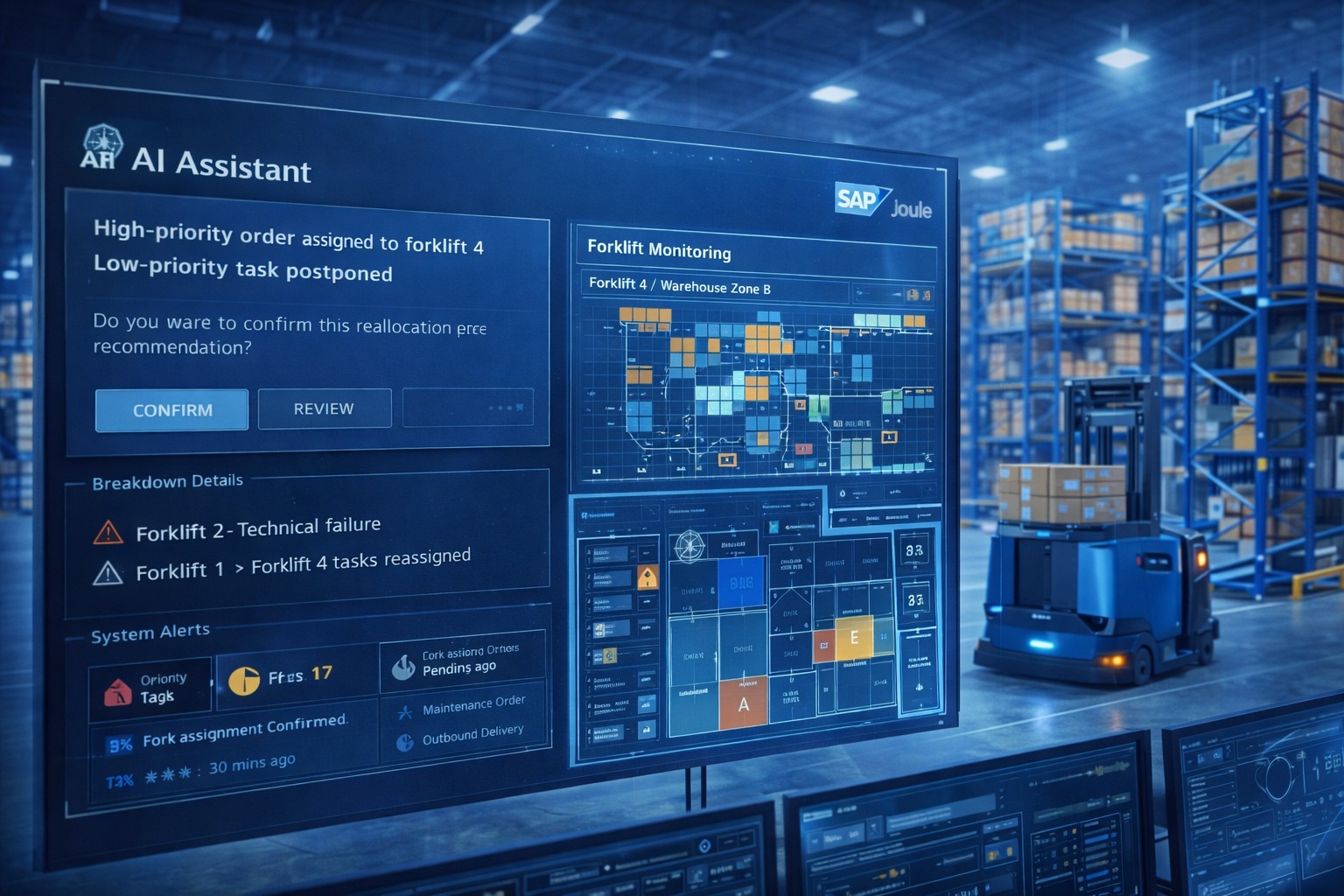
Imagine a forklift failure detected through an IoT sensor.
In traditional workflows:
- Maintenance logs the issue
- Warehouse supervisors manually review tasks
- Resources are reassigned manually
With SAP Joule:
- The system analyzes affected warehouse tasks
- Evaluates delivery priorities
- Identifies available equipment and operators
Joule can then propose an optimized task reallocation plan.
Managers receive a structured recommendation and can approve the adjustment instantly.
This significantly reduces disruption response time.
Technical Foundations for AI Integration in SAP EWM
AI integration requires a structured technology architecture.
Most implementations combine:
- SAP EWM
- SAP Business Technology Platform (SAP BTP)
- AI models and analytics services
- IoT or robotics systems (optional)
Before implementing AI, organizations should prepare three critical areas.
1. Data Readiness
AI models depend heavily on clean operational data.
Important data elements include:
- Accurate product attributes (dimensions, weight, storage conditions)
- Historical warehouse task logs
- Picking times and labor performance data
- Inbound and outbound shipment history
Typically, 12–24 months of historical data is required for reliable predictions.
Poor data quality can significantly reduce model accuracy.
2. Integration Architecture
AI models are typically hosted on SAP Business Technology Platform.
Integration occurs through:
- Secure APIs
- Event-based messaging
- Data pipelines connecting SAP EWM and AI services
Organizations may choose between:
Standard AI capabilities
Using SAP Joule and predefined AI services embedded in SAP.
Custom AI models
Developing models on SAP AI Core or external ML platforms and connecting them to EWM through APIs.
The approach depends on how specialized the warehouse processes are.
3. Pilot-Driven Deployment
AI implementation should begin with a focused pilot project.
Ideal starting points include:
- High-volume warehouse zones
- Products with frequent congestion issues
- Processes with measurable KPIs
Pilots allow organizations to validate:
- Model accuracy
- Operational impact
- System stability
before expanding across the entire warehouse.
FAQs: AI in SAP EWM
Can AI work with decentralized SAP EWM systems?
Yes. While S/4HANA-embedded EWM simplifies integration, AI can also be implemented in decentralized environments using side-by-side architecture on SAP BTP.
Can AI automatically execute warehouse decisions?
Most implementations begin with recommendation mode, where AI suggests actions but humans approve them.
Once validated, certain workflows can move toward controlled automation.
What data is required for AI warehouse models?
Typical datasets include:
- Warehouse task logs
- Picking performance data
- Inventory attributes
- Inbound and outbound shipment history
- IoT telemetry from equipment or robots
The Future of AI-Powered Warehousing
AI transforms SAP EWM from a reactive execution system into a predictive operational platform.
By combining machine learning, IoT data, and intelligent workflows, organizations can:
- Reduce warehouse travel time
- Improve labor productivity
- Prevent operational disruptions
- Maintain higher inventory accuracy
However, successful adoption depends on data quality, system architecture, and structured implementation.
Companies that align warehouse operations expertise with AI engineering capabilities will unlock the greatest value from intelligent warehousing.